
The Frequency Diplexer as a Combiner
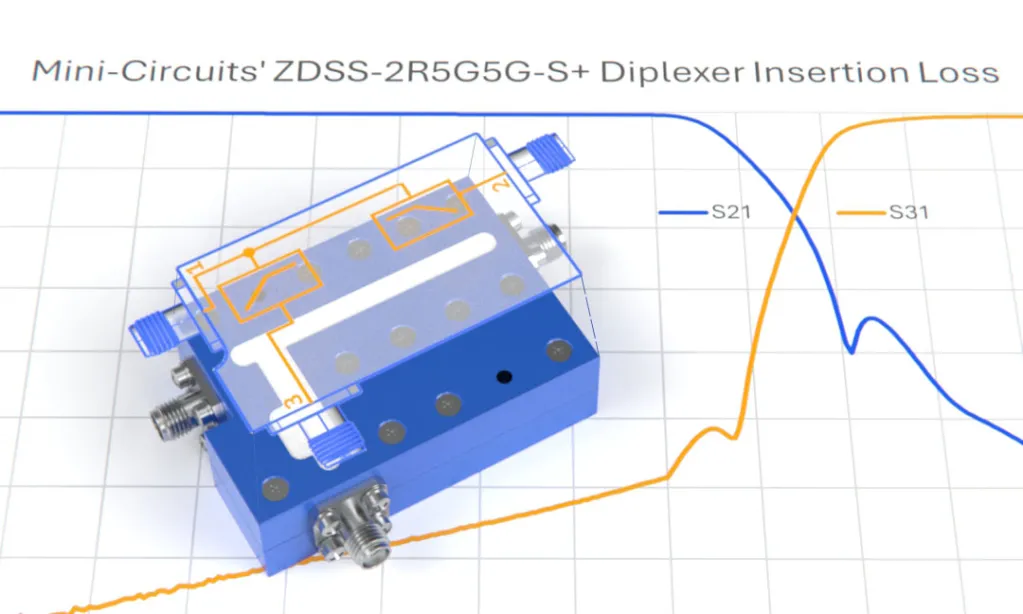
Frequency diplexers (henceforth simply diplexers) serve to either divide (demultiplex) the frequency spectrum into two major sub-bands or perform the complementary function of frequency multiplexing where the two sub-bands are combined to form a full frequency spectrum. The focus of this article is the latter, the combining of two signals or sub-bands into one contiguous spectrum. Diplexers are a 3-port component comprised of 2 ports for the individual sub-bands and a third port defined as the full-band input or output, depending upon the orientation in which it is applied.
Diplexers are important because they allow two or more devices that operate on disparate frequencies to share a single transmission medium at the same time without interfering with one another. Since they reduce system cabling and complexity, they are considered economical to use for commercial wireless base stations, aerospace and defense systems, satellite communications (SATCOM) terminals, and for consumer electronics devices that operate over Wi-Fi and Bluetooth.
How Loops and Probes Couple to Cavity Filters

Astonishingly, 200 years ago in France in 1826, Felix Savary observed the oscillatory nature of Leyden jar discharges. This oscillatory behavior is an essential requirement for resonance.1 The theory of resonance would take another 50 years to mature. In 1887, Heinrich Hertz in Germany devoted one section of his papers to describing his experimental observations of what he called “Resonance Phenomena”.1 That is nearly 150 years ago, which is still amazing.
Cavity filters are ubiquitous today, and they are not new to the world of RF and microwave engineering. Cavity filters have been around for almost 80 years, since Fano and Lawson completed their initial work in 1948.2,3 They are widely used in RF and microwave systems where high selectivity, low insertion loss, and excellent power handling are required. They are commonly found in SATCOM, radar, EW, ECM, and even test and measurement systems. One critical aspect of cavity filter design is how energy is coupled into and out of the resonant structure. Among the various techniques available, coupling loops and coupling probes (henceforth, more commonly “loops” and probes”) are the two most common methods. Each method relies on a different electromagnetic coupling mechanism and offers distinct advantages depending on frequency, power level, bandwidth, and mechanical constraints.
This article furnishes the reader with a basic understanding of the operating principles, design considerations, and practical tradeoffs of loop and probe coupling methods for cavity filters.
RF/Microwave Micro-Ceramic LTCC Filters for Stripline, Microstrip and Co-Planar Waveguide (CPWG) Launches

RF Design Engineer, William Yu explains the different implementations of Mini-Circuits micro-ceramic (LTCC) filters in this demo from Mini-Circuits’ engineering lab in Brooklyn, NY.
The demonstration compares standard filter designs with wraparound terminals to Mini-Circuits’ patented high-rejection designs on stripline as well as microstrip traces. Low-pass and high-pass filter models are examined, and filter S21 responses for each measured on a network analyzer to illustrate filter performance in each case.
Anatomy of a 37-40 GHz 5G n260 Band Front-End with a Discrete LO

The appetite for greater download speeds and lower latency amongst modern mobile device users can be satisfied by higher RF bandwidths. The greatest bandwidths available are found in the mmWave bands, such as 5G band n260 (often referred to as the 39 GHz band, or upper Ka band) which spans 37 to 40 GHz. Although signals in the mmWave band region have the shortest range and poorest ability to penetrate obstacles like buildings and irregular terrain, they do afford the opportunity to achieve incredibly high data rates. Devices capable of receiving the 5G n260 band are theoretically capable of achieving download speeds of up to 20 Gbps under ideal conditions, such as over a short range (< 500 meters) and for line-of-sight transmission. Under real-world conditions, one of the major telecommunications network operators has deployed a 5G FR2 n260 band solution that offers speeds up to 3 Gbps1, and every one of the top three operators has deployed n2601, predominantly where dense wireless traffic is located – stadiums, convention centers, large urban areas, etc.
How to Build a High-Performance SSB Upconverter

Upconverters are ubiquitous in modern RF systems, translating everything from baseband quadrature DDS signals to many of today’s mmWave signals. An X-band upconverter with sideband suppression utilizing an IQ mixer is prototyped in this article to enable the reader to better understand the up-conversion process and the mathematics behind sideband suppression itself.
While integrated forms of upconverters are widely available for many applications, it is interesting to construct a modular upconverter with a significant number of Mini-Circuits’ parts to see how the components interact and how each contributes to overall system performance. Filtering, frequency multiplication, amplification, signals in quadrature, and sideband suppression are a few of the concepts covered when reviewing the system architecture. Finally, we discuss use cases where up-conversion combined with sideband suppression is essential for achieving RF system performance goals.
A Dual Band Channel Sounder Module for FR1 & FR3 Band Modelling (6.75 GHz & 16.95 GHz)
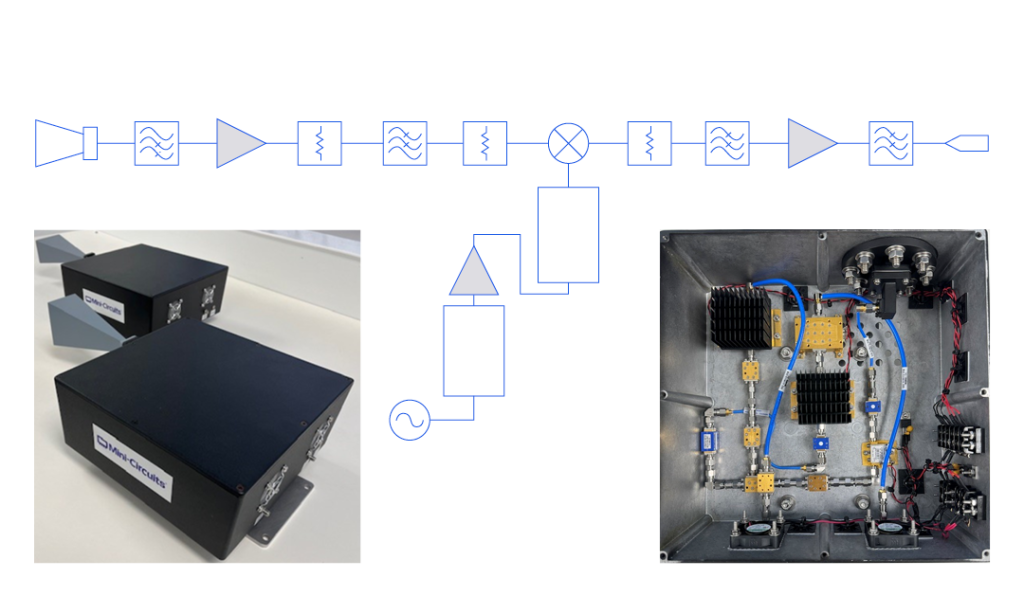
While much research has been devoted to exploring millimeter-wave bandwidths for high-data-rate wireless communications, much of the deployment of 5G to date has relied on frequencies in the sub-6 GHz (FR1) region of the spectrum. The channel capacity of the FR2 bands has been used in urban environments with high subscriber demand where infrastructure can be installed with sufficient density to compensate for the short range and poor penetration of high-frequency signals. Meanwhile, network operators still rely on lower-frequency signals for more ubiquitous coverage.
Similar desire for the data capacity and speed of millimeter-wave and sub-THz transmissions with broad network coverage and low power requirements of lower frequencies has spurred strong interest in the FR3 bands (7 to 24 GHz) as a possible “Goldilocks zone” for the next phases of 5G and 6G development.
Professor Ted Rappaport and his graduate research fellows of NYU WIRELESS in Brooklyn, New York are among the leading researchers exploring the propagation characteristics of 5G and 6G frequency bands under consideration for commercial use by the ITU and telecom industry. In 2022 Rappaport and his team visited Mini-Circuits’ facilities in Brooklyn, and Deer Park on Long Island as a test bed for their work to develop the first spatial statistical model for ultra-wideband signals above 100 GHz in a real-world factory environment.
Group Delay in RF Filters
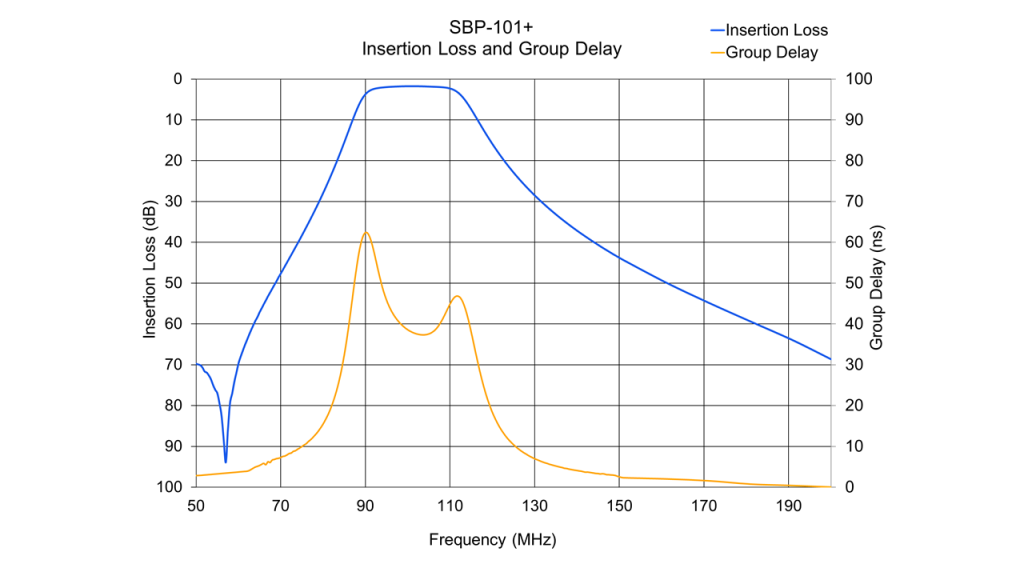
The concept of group delay as it pertains to RLC networks was first described by Harry Nyquist in 1928.1 The contributions Nyquist made to the field of Communications Theory are well known,2 and still applicable to modern day communications systems. On our way toward understanding group delay in this brief application note, we’ll start by examining phase delay. After mathematically defining phase delay, we will then continue by defining group delay. Illustrations of amplitude response, and phase and group delay response for several ideal filters of various filter topologies are shown. This app note concludes with a display of magnitude and group delay frequency response curves for two real filters designed and manufactured by Mini-Circuits, both of which have the same filter topology.
Frequency Modulation Fundamentals
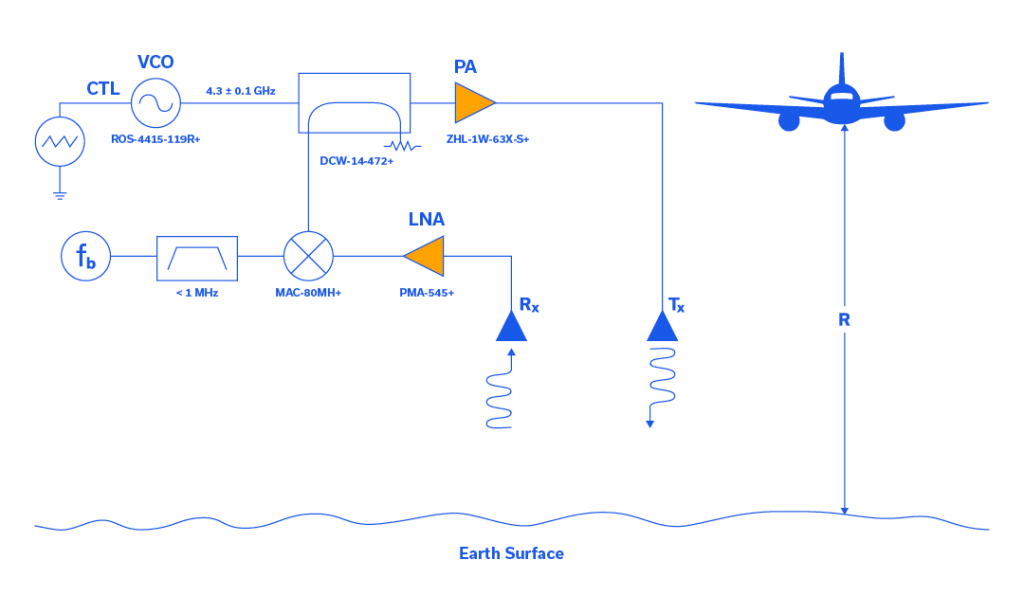
In the 1920s, many brilliant scientists applied themselves to the study of frequency modulation (FM). One of these scientists was a communications systems theorist who worked for AT&T named John Renshaw Carson. Carson performed a comprehensive analysis of FM in his 1922 paper which yielded the Carson bandwidth rule.1 Carson was so convinced that FM was not a suitable solution to the static found in AM transmission systems that he once remarked, “Static, like the poor, will always be with us.”2
Beginning in 1923, in Columbia University’s Marcellus Hartley Research Laboratory, in the basement of Philosophy Hall, a driven genius in electronic circuitry named Edwin Howard Armstrong set out to reduce static through the use of FM. After approximately 8 years of toil, Armstrong had a brainstorm and decided to challenge the assumption that the FM transmission bandwidth had to be narrow to keep noise low. After painstakingly designing this new FM system, with as many as 100 tubes spread over several tables in the laboratory, “[Armstrong] was able to prove that wideband FM made possible a drastic reduction of noise and static.”3 Armstrong was issued patent number US1941069A, which specifically addresses noise suppression in wideband FM, on December 26, 1933, along with three additional patents for FM that same day.
The Basics of Orthogonal Frequency-Division Multiplexing (OFDM)
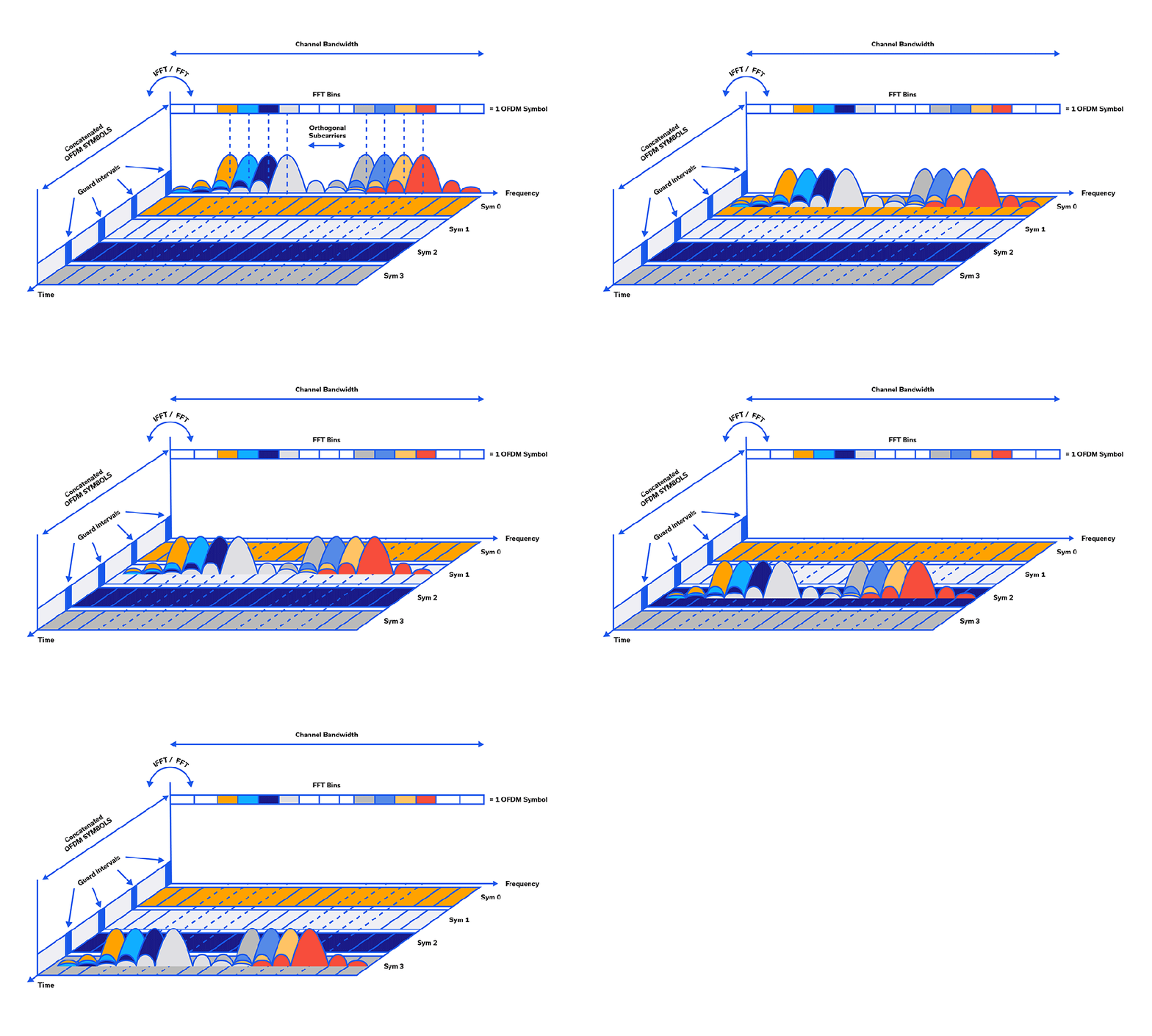
While traditional Frequency Division Multiplexing has been around for over 100 years, Orthogonal Frequency Division Multiplexing (OFDM) was first introduced by Robert W. Chang of Bell Laboratories in 1966.1,2,3,4 In OFDM, the stream of information is split between many closely-spaced, narrowband subcarriers instead of being relegated to a single wideband channel frequency.5 Single-channel modulation schemes tend to be sequential whereas, in OFDM, many bits can be sent in parallel, simultaneously, in the many subcarriers.5 So many bits can be packed onto the subcarriers simultaneously that the data rate of each subcarrier’s modulation can be much lower than that of a single-carrier architecture.
LTCC High Pass Filters for mmWave
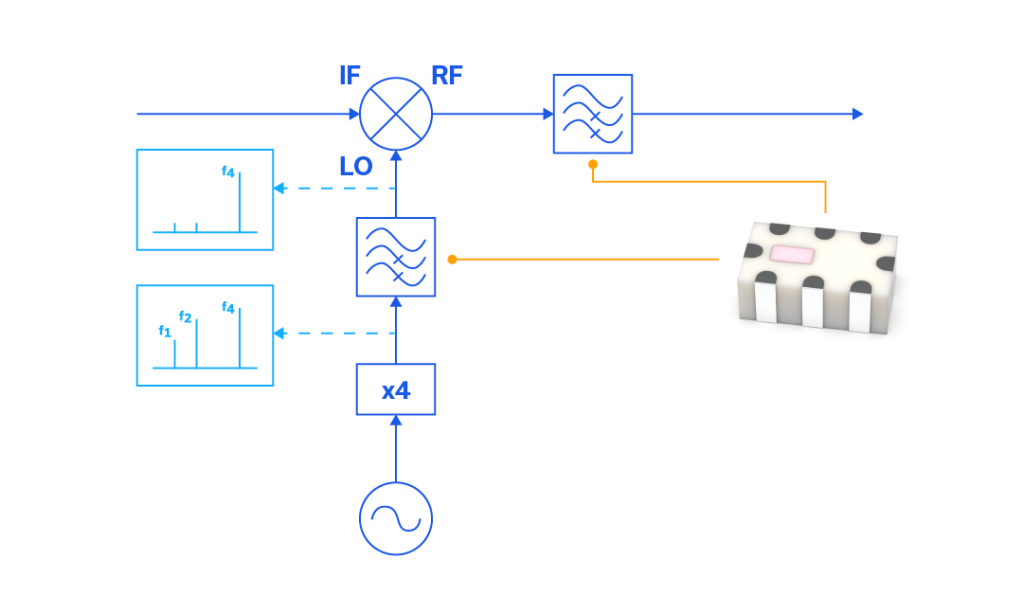
Mini-Circuits has introduced new high pass filters that achieve breakthrough performance for Q-band and lower V-band applications up to 58 GHz. The HFCQ, HFCN, and HFCV LTCC filters offer a combination of low insertion loss, high return loss, excellent rejection, small size, cost-effectiveness, repeatability, ruggedness and reliability. These filters enable designers to cover filter blocks with traditional SMT technology versus more exotic solutions. Key benefits include smaller footprint compared to stripline filters, repeatable performance suited for volume production, and robustness. The filters simplify designs for applications like 5G FR2 and satellite communications. Mini-Circuits’ latest LTCC high pass filters set a new standard for electrical performance and ease of implementation in demanding mmWave systems.