
TEST
SOLUTIONS
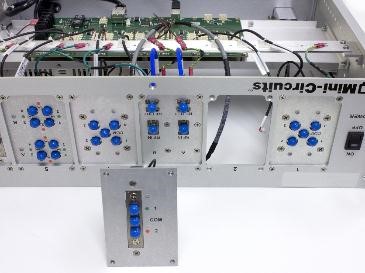
Mini-Circuits has developed a range of test systems for characterizing wireless mesh network devices. All external ports of the mesh are interconnected to simulate an over-the-air wireless mesh configuration. Programmable attenuators on each internal path allow the path loss to be varied independently between any pair of devices, without affecting communication between any other pair. This configuration allows the simulation of real-world mesh characteristics within a confined lab or production environment.
Best viewed on desktop.
Please use the below filters to narrow down your search according to your required parameters.
You may also sort each column (alphabetic or numeric) by clicking on their header.
Fill out the form if you need help choosing a part, need samples or if you have any questions, and we will get back to you as soon as possible.
An RF mesh network test system interconnects the RF ports of three or more wireless devices through a matrix of programmable attenuators, so their signals reach each other over cabled paths instead of over the air. Each internal path has its own independently controlled attenuator, letting you set the path loss between any pair of devices without affecting any other pair. This recreates the varying signal strengths of a real-world mesh network inside a shielded, repeatable lab or production environment. Mini-Circuits’ ZTMN series offers these systems in configurations from 4 to 16 ports.
Over-the-air testing is hard to repeat: reflections, interference, and moving objects change the results every time. A conducted mesh test system replaces the air path with cabled, attenuator-controlled paths, so every device-to-device link has a precisely known, repeatable loss. This lets engineers reproduce specific network topologies and fault conditions on demand, run automated regression tests, and isolate device behavior from environmental noise — essential for both R&D characterization and high-volume production testing.
The systems are designed for characterizing wireless mesh and multi-node devices, with the ZTMN catalog covering common standards by frequency. Applications include Bluetooth and Zigbee devices, Wi-Fi systems, and wireless handsets. The frequency options map to real bands: sub-GHz IoT and Zigbee (models from 5–1000 MHz), 2.4 GHz Bluetooth/Wi-Fi and 5/6 GHz Wi-Fi (models reaching 6000–8000 MHz), and cellular handset bands. Choosing the model whose frequency window covers your device’s band is the main selection step.
The hero concept is “3 to N” ports, and the standard catalog offers 4, 6, 8, 9, 10, 12, and 16-port systems. For example, the ZTMN-0495 models handle 4 devices, the ZTMN-0895 models handle 8, the ZTMN-1295A-N handles 12, and the ZTMN-1695B-S connects 16 devices across the 500–7200 MHz range. Every port pair is linked by its own attenuator, so a 16-port system simulates a densely interconnected mesh. Larger custom configurations beyond 16 ports are available.
Across the standard ZTMN catalog, frequency coverage runs from as low as 5 MHz (ZTMN-0695E-S) up to 8 GHz (ZTMN-0695C-S), with most models offering per-path attenuation ranges of 95 dB (a few at 90 dB). This covers the sub-GHz, 2.4 GHz, 5 GHz, and 6 GHz bands used by most mesh and IoT devices. For applications needing higher frequencies or wider attenuation, Mini-Circuits builds custom systems reaching up to 40 GHz and 120 dB of attenuation.
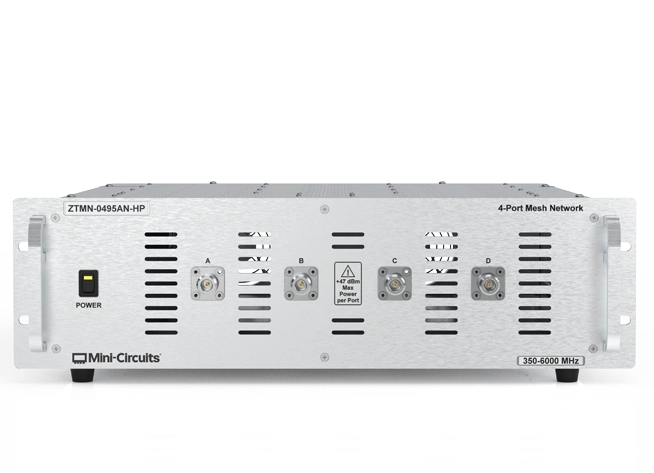
The HP models — the ZTMN-0495AN-HP (350–6000 MHz) and ZTMN-0495BN-HP (10–800 MHz) — accept up to 47 dBm (about 50 W) of input power, versus roughly 25–37 dBm for standard models. High input-power handling matters when devices under test transmit at high power, or when you need extra headroom to avoid compressing or damaging the attenuators. Both HP models are 4-port, 3U systems with N-type connectors, suited to higher-power radios and base-station-class devices.
The ZTMN catalog offers three connector types — N-type, SMA, and TNC — in rack heights of 2U, 3U, and 5U depending on port count. Lower-port 4–8 port systems are typically 2U or 3U, while the higher-density 10, 12, and 16-port systems (such as the ZTMN-1295A-N and ZTMN-1695B-S) are 5U to house the larger attenuator matrix. N-type and TNC are common on higher-power and lower-frequency models, while SMA is used across the mid and upper frequency ranges. MCDI can advise on the best connector choice for your test rack.
In a real mesh, each device hears its neighbors at different signal strengths, and those strengths change as nodes move or conditions shift. Independent per-path attenuation lets you set and vary the loss between any two specific devices without touching the others — so you can simulate a distant node, force traffic to reroute, or test roaming and self-healing behavior in a controlled way. This granular control is what makes a conducted system a true mesh simulator rather than a simple splitter network.
Yes. Every ZTMN system is controlled via USB and Ethernet, so attenuator settings on all paths can be scripted and changed programmatically. This allows the system to step through a sequence of network scenarios automatically — different topologies, signal levels, and fault conditions — as part of an automated test routine on a production line or in a validation lab. Integration with common test software and programming environments makes it straightforward to add to an existing automated test setup.
Yes. Beyond the standard ZTMN catalog, Mini-Circuits builds custom mesh network test systems — for higher port counts, extended frequencies up to 40 GHz, wider attenuation up to 120 dB, or specific connector and power requirements. MCDI, the exclusive representative of Mini-Circuits in Israel, has an application engineering team that helps you select a standard model or specify a custom configuration, request samples, and get local technical support. You can reach MCDI at 077-5406075, through the website contact form, or via WhatsApp.




Before you leave, you should know that MCDI’s professional team of Application Engineers will be delighted to assist you in sourcing the right component. Just fill the form and we will be back to you shortly.