

TEST
SOLUTIONS
Mini-Circuits offers a wide selection of solid-state RF switches for test and measurement applications, from compact switch modules to complex, rack-mountable switch matrices with integrated attenuation and other functions. Our wealth of components in-stock allows us to configure affordable high-performance systems to customers’ unique needs with fast turnaround. Switches feature TTL, SPI and I2C control ports, and our unique daisy-chain interface on some models provides added flexibility to control multiple switches on a single control line to scale your switching configuration as your needs change.
Best viewed on desktop.
Please use the below filters to narrow down your search according to your required parameters.
You may also sort each column (alphabetic or numeric) by clicking on their header.
Fill out the form if you need help choosing a part, need samples or if you have any questions, and we will get back to you as soon as possible.
Fill out the form if you need help choosing a part or if you have any questions, and we will get back to you as soon as possible.
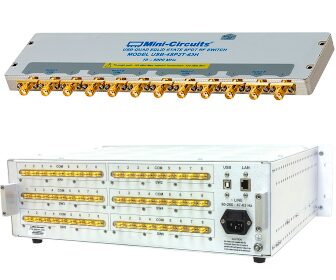
An RF solid state switch matrix is a rack-mount or modular system that routes RF signals between multiple ports electronically, using semiconductor switch elements (PIN diode or FET) instead of moving mechanical contacts. Because there are no moving parts, switching happens in nanoseconds and the unit has effectively unlimited switching life, making it the standard choice for automated test systems that cycle millions of times. Mini-Circuits systems combine SPDT, SP4T, SP8T, SP16T and higher-order switch blocks into configurations up to 67 GHz, controlled over USB, Ethernet, TTL, SPI, I²C or daisy chain.
The ESB-1SP2T-A673, ESB-1SP4T-A673, RCS-1SP2T-A673 and RCS-1SP4T-A673 all operate from 100 MHz to 67 GHz, covering 5G FR2, satcom Ka/V-band and automotive radar test. They provide 45 dB typical isolation, 4–6.5 dB insertion loss, VSWR of 1.4–1.5:1 and 600 ns transition time, and run on USB 5 V power with daisy-chain (and Ethernet, on the RCS models) control.
Mini-Circuits solid state switches offer transition times as fast as 5 ns, with catalog models such as the USB-1SP2T-183, USB-1SP2T-34, USB-1SP2T-A44 and USB-1SP4T-183 specified at 10 ns typical and the TTL-1SP4T-183 and TTL-1SP8T-183 at 50 ns. For comparison, electromechanical switch matrices typically transition in 10–20 ms — roughly a million times slower — which is why solid state is used for fast beam-steering, hopping and high-throughput production test.
The U2C-1SP2T-63VH delivers 110 dB typical isolation from 10 MHz to 6 GHz, the highest in the line, followed by the USB-1SP16T-83H at 100 dB (1 MHz–8 GHz) and the USB-1SP8T-34 and USB-2SP4T-852H at 80 dB. High isolation matters when a strong transmit path sits adjacent to a sensitive receive path, or when measuring low-level signals such as receiver sensitivity and spurious emissions.
An absorptive switch terminates its unselected ports into an internal 50 Ω load rather than leaving them open or shorted, so reflected energy is dissipated instead of being sent back toward the source. This keeps VSWR low on all ports — typically 1.20:1 to 1.60:1 across the Mini-Circuits range — which protects sensitive DUTs and amplifiers and prevents standing waves from corrupting measurement accuracy. All switches in the Mini-Circuits solid state absorptive line, from the USB-1SP2T-183 up to the ESB-1SP4T-A673, are absorptive by design.
The ZTS-1SP80T-852 provides SP80T switching — one common port routed to 80 outputs — in a 2U rack, covering 10 MHz to 8.5 GHz with N-type and SMA connectors. The ZTS-1SP64T-852 offers SP64T in the same 2U form factor, and the ZT-320 packs 30 individual SP8T switches into 4U (1–6000 MHz). For dense SPDT applications the ZTS-32SP2T-63VH holds 32 SPDT switches in 5U (100–6000 MHz).
Most Mini-Circuits solid state switch modules handle 0.25 W to 1 W of input power, with the MEM-SP4T-A18 rated highest at 25 W (DC–18 GHz), followed by the USB-2SP2T-DCH at 3.15 W and the U2C-1SP2T-63VH at 2 W. If your application exceeds these levels, an electromechanical switch matrix or a dedicated high-power test system is the correct choice, since power handling is the main trade-off you accept in return for nanosecond switching speed.
Choose solid state when you need nanosecond-to-microsecond switching, very high cycle counts, and silent, vibration-free operation; choose electromechanical when you need lower insertion loss, higher power handling and better isolation at low frequencies. Solid state switches in this range show 1.0–7.5 dB insertion loss (USB-SP4T-63 is lowest at 1.0 dB), whereas mechanical relays typically stay below 0.5 dB but wear out after a few million cycles. Many test racks use both: solid state for fast-cycling signal routing, mechanical for high-power or calibration-critical paths.
Mini-Circuits solid state switches support USB, Ethernet/LAN, TTL, SPI, I²C and a proprietary daisy-chain interface, with a user-friendly GUI and a full API included at no extra cost. Daisy chaining — available on models such as the USB-1SP8T-183, ZTS-16SP4T-852, ZT-320 and ZTS-2SP16T-852 — lets multiple switches share a single control line, so you can scale a switching configuration without adding host ports or cabling. DLLs and ActiveX/COM objects support C#, C++, Python, MATLAB and LabVIEW for integration into an automated test executive.
Yes. Mini-Circuits builds custom rack-mount switch matrices with fast turnaround, and can integrate programmable attenuators, amplifiers, filters, splitters/combiners and other functions into the same chassis. Standard racks range from 1U to 5U with SMA or N-type connectors on the front panel, rear panel, or both — for example the ZTS-1SP8T-852 (1U, front SMA), the ZTS-6SP8T-852R (3U, rear SMA) and the ZT-24SP2T-63VH (4U, N-type, front and rear). MCDI’s application engineers in Israel can specify a configuration against your port count, frequency range, isolation and control requirements.
You can buy Mini-Circuits solid state switch matrices in Israel via MCDI, the exclusive representative of Mini-Circuits in Israel. MCDI also has an application engineering team that helps you with your local support needs. Reach MCDI at 077-5406075, via the website contact form, or on WhatsApp.




Before you leave, you should know that MCDI’s professional team of Application Engineers will be delighted to assist you in sourcing the right component. Just fill the form and we will be back to you shortly.