

TEST
SOLUTIONS
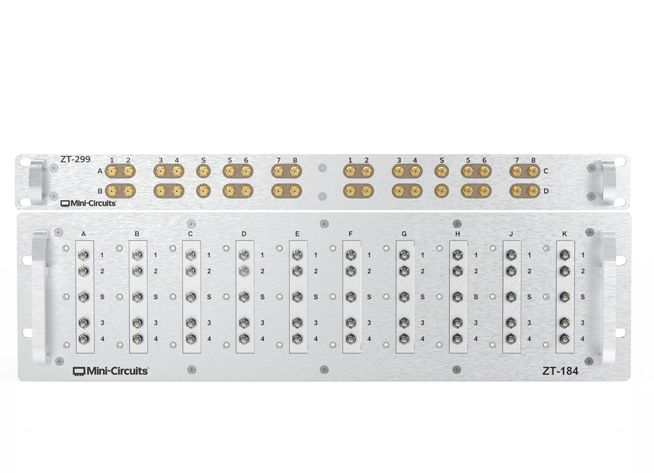
Mini-Circuits’ panel-mounted structures provide clean, organized management of cable runs and connections in complex, high-volume test setups. Multiple connector adapters, power splitters, directional couplers and other essential RF components and test accessories can be integrated efficiently within the test system. Custom configurations are available upon request.
Best viewed on desktop.
Please use the below filters to narrow down your search according to your required parameters.
You may also sort each column (alphabetic or numeric) by clicking on their header.
Fill out the form if you need help choosing a part, need samples or if you have any questions, and we will get back to you as soon as possible.
RF panel mounted structures are 19-inch rack-mount panels populated with coaxial connectors, adapters, and other RF components, used to organize cable runs and connections in complex test racks. Instead of cables running loose between instruments and devices under test, connections terminate at a clearly laid-out front panel with matching rear-panel feedthroughs. This makes busy, high-volume test setups easier to build, document, troubleshoot, and reconfigure, and reduces wear on instrument connectors by moving the frequently-mated connection to the panel.
An RF patch panel is a passive structure: it provides fixed feedthrough connections between the front and rear of a rack, with no switching or active components. A switch matrix, by contrast, actively routes signals between inputs and outputs under software control. Patch panels solve cable management and connector accessibility; switch matrices solve automated signal routing. Many test racks use both — a matrix for programmable routing, and panels to bring connections neatly to the rack face.
The standard catalog covers four connector types: SMA, N-type, 2.92 mm, and 4.3-10, all in female (f) configuration on both faces. SMA panels handle up to 18 GHz, N-type panels up to 11 or 18 GHz, 2.92 mm panels up to 40 GHz, and 4.3-10 panels up to 6 GHz. Connector choice is driven by your frequency range and by what the rest of your test rack uses.
The ZT-96KFFL-KF50 is the densest, with 96 2.92 mm (f) connectors in a 5U panel covering DC–40 GHz. For high density at lower rack height, the ZT-314D packs 80 SMA (f) connectors into just 2U (DC–18 GHz). Other high-count options include the ZT-182 and ZT-183 with 48 connectors in 4U. At the compact end, 1U panels such as the ZT-312, ZT-346, ZT-396, and ZT-412 provide 12 to 18 connections.
Three models use precision 2.92 mm (f) connectors and cover DC–40 GHz: the ZT-8KFFL-KF50+ (8 connectors, 1U), the ZT-32KFFL-KF50 (32 connectors, 2U), and the ZT-96KFFL-KF50 (96 connectors, 5U). These are the right choice for millimeter-wave test racks where SMA would degrade signal integrity. The 2.92 mm interface is mechanically compatible with SMA, but rated to far higher frequency.
Yes — several models use a different connector on the front and rear face, letting the panel act as an organized bank of adapters. The ZT-183 has N-type (f) on the front and SMA (f) on the rear (48 connections, DC–18 GHz, 4U), the ZT-312 offers the same N-to-SMA conversion in a compact 1U with 12 connections, and the ZT-427BK converts SMA (f) front to 4.3-10 (f) rear (24 connections, DC–6 GHz, 3U). This removes the need for loose adapters, which are easy to lose and add failure points.
The 4.3-10 is a lower-PIM coaxial connector standard developed for cellular infrastructure, offering better passive intermodulation performance and easier mating than older DIN 7-16 connectors, in a smaller footprint. It’s widely used in base-station and mobile network equipment. In this catalog, the ZT-349 provides 24 4.3-10 (f) connections front and rear (DC–6 GHz, 3U), and the ZT-427BK converts SMA to 4.3-10 — useful when interfacing lab test equipment with cellular infrastructure hardware.
Panels are offered in 1U, 2U, 3U, 4U, and 5U. The choice is a trade-off between connector count and rack space: 1U panels give 8 to 18 connections and suit racks where space is at a premium, while 4U and 5U panels carry 48 to 96 connections for large multi-DUT setups. Note that density isn’t purely a function of height — the ZT-314D fits 80 SMA connections in 2U, while the N-type ZT-240 fits 24 in 4U, because N-type connectors are physically much larger.
Yes. Beyond plain connector adapters, panels can integrate power splitters, directional couplers, and other essential RF components and test accessories directly into the panel, so those functions sit in the signal path without additional boxes or cabling. Mini-Circuits builds custom configurations to order with fast turnaround, which is particularly useful when a standard catalog panel almost fits but you need a specific mix of connector types, counts, or integrated components.
MCDI is the exclusive representative of Mini-Circuits in Israel. Their application engineering team can help you select the right standard panel, spec a custom configuration with integrated splitters or couplers, request samples, and provide local technical support and quotes. You can reach MCDI by phone at 077-5406075, through the website contact form, or via WhatsApp.




Before you leave, you should know that MCDI’s professional team of Application Engineers will be delighted to assist you in sourcing the right component. Just fill the form and we will be back to you shortly.