

Product Highlight: ZVE 18GB+ Wideband RF Low Noise Amplifier (LNA) with High Linear Output Power
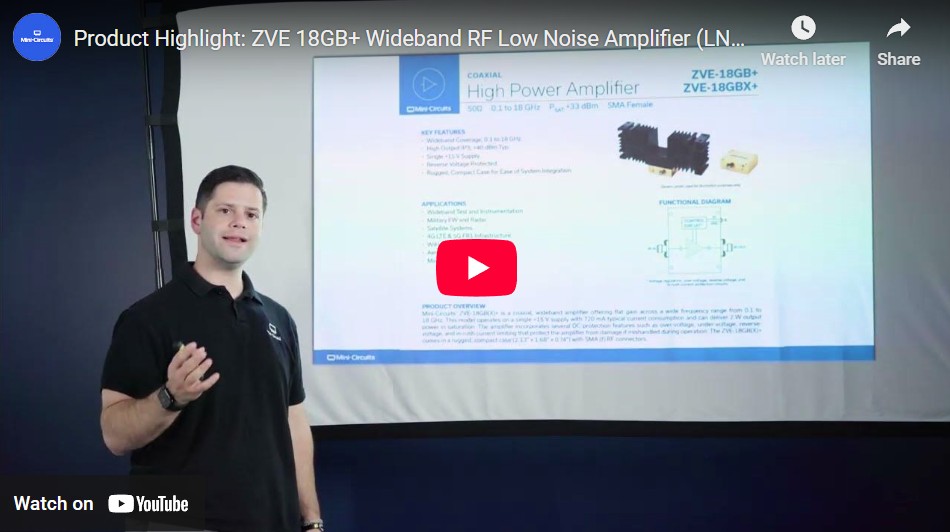
Mini-Circuits’ High-Frequency Product Line Engineering Manager, Dan Ford explains the unique features of the ZVE-18GB+ wideband low noise amplifier (LNA) operating from 0.1 to 18 GHz. This model was designed for modern RF systems requiring high linear output power and low noise performance for improved system signal-to-noise ratio (SNR). Operating on a single +15V supply with built-in DC protection features, the amplifier achieves flat gain of ~30 dB across its full bandwidth, greater than 1W output power at 1 dB compression (greater than 2W at saturation), and +40 dBm OIP3.
Understanding Additive Phase Noise in RF & Microwave Amplifiers – Part 4
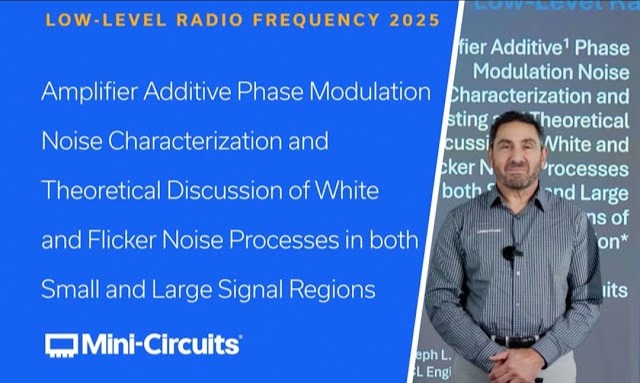
Mini-Circuits R&D Fellow, Joe Merenda recently presented a tutorial on Amplifier Additive Phase Noise at the 2025 Low-Level Radio Frequency Workshop at the Thomas Jefferson National Accelerator Facility in Newport News, VA. In this fourth episode of our Additive Phase Noise series, he shares this tutorial for the benefit of the broader RF and microwave engineering community. In this session, Joe explains the measurement setup and reviews fundamentals of additive phase noise theory. He then discusses differences between small signal and large signal behavior and the effect of AM-PM distortion on APN performance. The tutorial concludes with practical cases of additive phase noise performance in various cascade design examples.
Outstanding OIP2 from a Small Dual MMIC Amplifier

Remarkably, the concept of the push-pull connection spans three centuries. William W. Dean of the Bell Telephone Company of Missouri first described the push-pull-connected telephone transmitter in Patent No. 549,477, dated November 5, 1895.1 Next, Sir John Ambrose Fleming invented the first vacuum tube in 19042 and while Lee De Forest added the grid to Fleming’s “valve” in 1906, calling it the “audion,” it was Fritz Lowenstein in his April 24, 1912 patent application who first discovered that applying a negative bias to the grid of De Forest’s tube turned it into an audio amplifier.
Edwin Henry Colpitts of the Western Electric Company was awarded Patent No. 1,128,292, for an “electric wave amplifier” on February 16, 1915, which covered the push-pull circuit by connecting two vacuum tubes like De Forest’s audions like a primitive precursor to the transistor.3,4 Over a hundred years ago, Colpitts recognized that “a certain amount of distortion in the output waves is avoided”3 by utilizing this configuration.
Anatomy of a 37-40 GHz 5G n260 Band Front-End with a Discrete LO

The appetite for greater download speeds and lower latency amongst modern mobile device users can be satisfied by higher RF bandwidths. The greatest bandwidths available are found in the mmWave bands, such as 5G band n260 (often referred to as the 39 GHz band, or upper Ka band) which spans 37 to 40 GHz. Although signals in the mmWave band region have the shortest range and poorest ability to penetrate obstacles like buildings and irregular terrain, they do afford the opportunity to achieve incredibly high data rates. Devices capable of receiving the 5G n260 band are theoretically capable of achieving download speeds of up to 20 Gbps under ideal conditions, such as over a short range (< 500 meters) and for line-of-sight transmission. Under real-world conditions, one of the major telecommunications network operators has deployed a 5G FR2 n260 band solution that offers speeds up to 3 Gbps1, and every one of the top three operators has deployed n2601, predominantly where dense wireless traffic is located – stadiums, convention centers, large urban areas, etc.
How to Build a High-Performance SSB Upconverter

Upconverters are ubiquitous in modern RF systems, translating everything from baseband quadrature DDS signals to many of today’s mmWave signals. An X-band upconverter with sideband suppression utilizing an IQ mixer is prototyped in this article to enable the reader to better understand the up-conversion process and the mathematics behind sideband suppression itself.
While integrated forms of upconverters are widely available for many applications, it is interesting to construct a modular upconverter with a significant number of Mini-Circuits’ parts to see how the components interact and how each contributes to overall system performance. Filtering, frequency multiplication, amplification, signals in quadrature, and sideband suppression are a few of the concepts covered when reviewing the system architecture. Finally, we discuss use cases where up-conversion combined with sideband suppression is essential for achieving RF system performance goals.
RF Amplifier and Filter Testing with Mini-Circuits Power Sensors
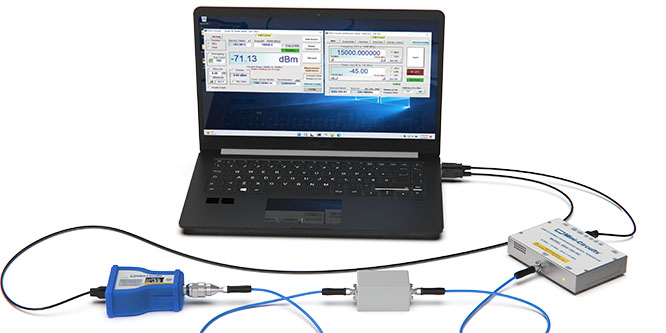
RF Amplifier and Filter Testing with Mini-Circuits Power Sensors Introduction When measuring common RF components, such as filters and amplifiers, RF power sensors provide an accurate, cost-effective way to obtain meaningful data. For RF filters, parameters such as insertion loss, return loss and desired frequency response (passband and stopband) should be considered. For RF amplifiers, […]
Wideband Amplifiers – Variable and Temperature-Compensated Gain

Wideband Amplifiers – Variable and Temperature-Compensated Gain
Many types of RF systems and applications that span from the upper end of microwave frequencies to the lower end of mmWave have arisen in recent years. Meeting system requirements over such a wide bandwidth and high frequency range, or even a broad sub-band requires that system performance parameters be stable, and the parameter that most often concerns microwave/mmWave system designers is gain. Mini-Circuits addresses these concerns with two amplifier types from our ZVA-series of wideband microwave/mmWave amplifiers that equip the system designer with either variable gain, or temperature-compensated, stable gain. Not only can gain be temperature-stable or variable, but at approximately 50 dB, it is also plentiful. Combine this with a low NF, high linearity and interactive telemetry, and Mini-Circuits’ wideband, variable and temperature-compensated gain amplifiers prove to be one of the highest-performing and most flexible amplifier solutions on the market today. Read on to find out how adjustable or temperature-stable gain and the ability to monitor output power can be beneficial when it comes to designing a system for any one of a number of applications.
A Dual Band Channel Sounder Module for FR1 & FR3 Band Modelling (6.75 GHz & 16.95 GHz)
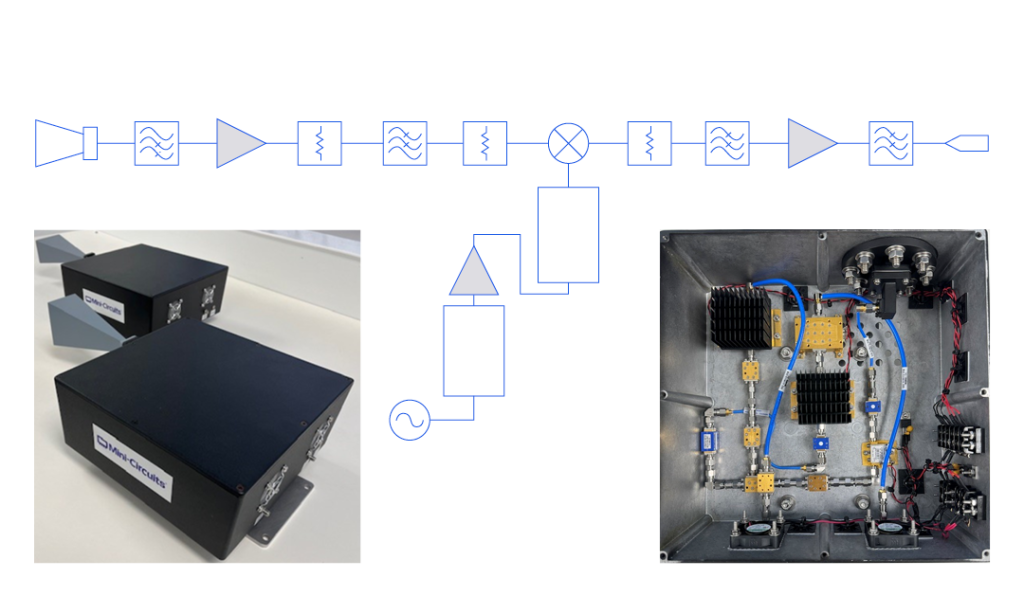
While much research has been devoted to exploring millimeter-wave bandwidths for high-data-rate wireless communications, much of the deployment of 5G to date has relied on frequencies in the sub-6 GHz (FR1) region of the spectrum. The channel capacity of the FR2 bands has been used in urban environments with high subscriber demand where infrastructure can be installed with sufficient density to compensate for the short range and poor penetration of high-frequency signals. Meanwhile, network operators still rely on lower-frequency signals for more ubiquitous coverage.
Similar desire for the data capacity and speed of millimeter-wave and sub-THz transmissions with broad network coverage and low power requirements of lower frequencies has spurred strong interest in the FR3 bands (7 to 24 GHz) as a possible “Goldilocks zone” for the next phases of 5G and 6G development.
Professor Ted Rappaport and his graduate research fellows of NYU WIRELESS in Brooklyn, New York are among the leading researchers exploring the propagation characteristics of 5G and 6G frequency bands under consideration for commercial use by the ITU and telecom industry. In 2022 Rappaport and his team visited Mini-Circuits’ facilities in Brooklyn, and Deer Park on Long Island as a test bed for their work to develop the first spatial statistical model for ultra-wideband signals above 100 GHz in a real-world factory environment.
Measurement of Amplifier Additive Phase Modulation Noise (APM)
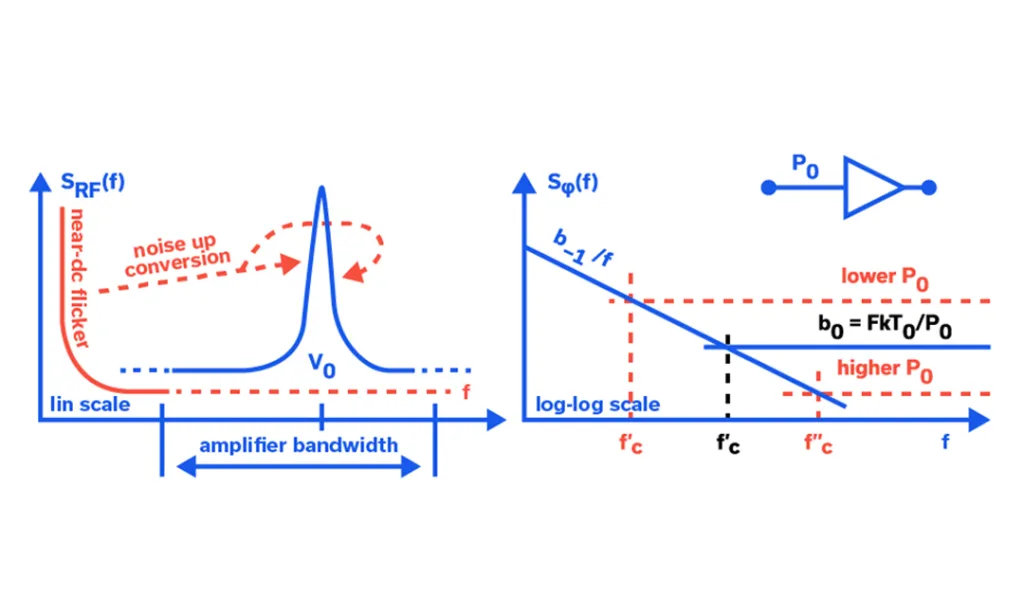
In our efforts to properly characterize the Additive Phase Modulation Noise (APM) and Additive Amplitude Modulation Noise (AAM) performance of MMIC amplifiers in our labs, Mini-Circuits is careful to consider the performance capabilities and limitations of our phase noise analyzer and test setup (see Figure 4). Both APM and AAM performance can be dependent upon the analyzer’s internal signal source carrier frequency, power level, and, importantly, the phase length from signal source output to RF input, so great care must be taken to optimize these parameters.
Frequency Modulation Fundamentals
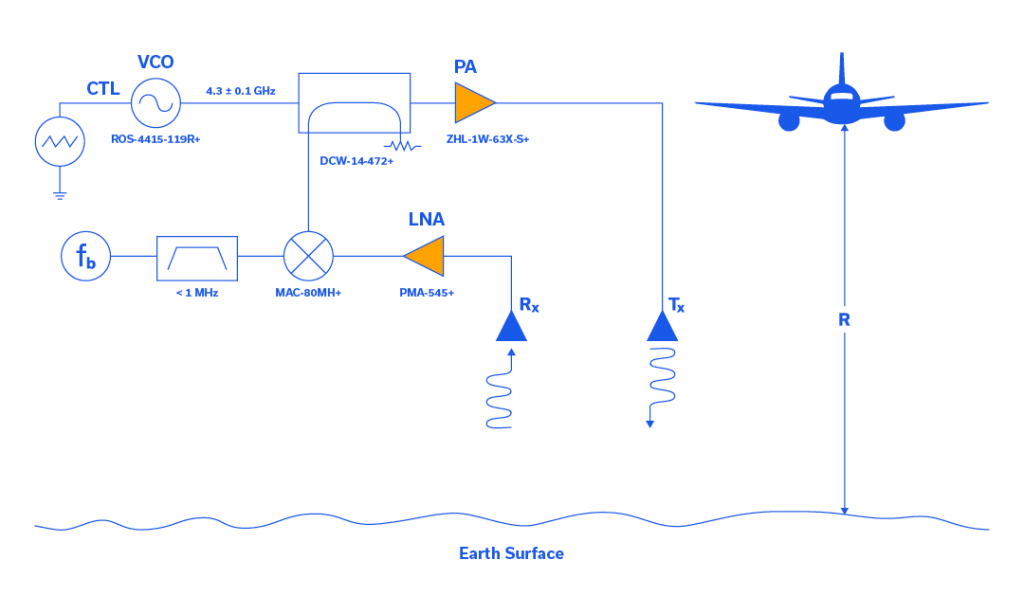
In the 1920s, many brilliant scientists applied themselves to the study of frequency modulation (FM). One of these scientists was a communications systems theorist who worked for AT&T named John Renshaw Carson. Carson performed a comprehensive analysis of FM in his 1922 paper which yielded the Carson bandwidth rule.1 Carson was so convinced that FM was not a suitable solution to the static found in AM transmission systems that he once remarked, “Static, like the poor, will always be with us.”2
Beginning in 1923, in Columbia University’s Marcellus Hartley Research Laboratory, in the basement of Philosophy Hall, a driven genius in electronic circuitry named Edwin Howard Armstrong set out to reduce static through the use of FM. After approximately 8 years of toil, Armstrong had a brainstorm and decided to challenge the assumption that the FM transmission bandwidth had to be narrow to keep noise low. After painstakingly designing this new FM system, with as many as 100 tubes spread over several tables in the laboratory, “[Armstrong] was able to prove that wideband FM made possible a drastic reduction of noise and static.”3 Armstrong was issued patent number US1941069A, which specifically addresses noise suppression in wideband FM, on December 26, 1933, along with three additional patents for FM that same day.