Mini-Circuits RF Frequency Mixers from 500 Hz to 65 GHz with Local Engineering Support in Israel
MCDI offers a broad selection of Mini-Circuits RF, microwave and millimeter-wave frequency mixers for frequency conversion in receivers, transmitters, radar, communications, test equipment and other RF signal-chain applications.
The portfolio includes double-balanced mixers, triple-balanced mixers, active mixers, I/Q mixers, dedicated up-converters and high-reliability mixer solutions, with surface-mount, connectorized, plug-in and MMIC bare-die configurations.
Mini-Circuits frequency mixers cover RF and LO frequencies from 500 Hz to 65 GHz, with a wide range of LO drive levels, IF bandwidths, conversion loss or gain, linearity and port-isolation performance.
Available technologies include Core & Wire, LTCC and MMIC, allowing designers to select solutions ranging from established low-frequency passive mixer architectures to highly integrated wideband millimeter-wave mixers.
MCDI’s Application Engineering team in Israel can assist you in selecting the appropriate mixer according to RF, LO and IF frequency requirements, LO drive level, conversion loss or gain, isolation, input P1dB, IP3, package and application.
An RF frequency mixer is a nonlinear component used to translate signals from one frequency range to another.
A conventional mixer has three primary signal ports:
RF – Radio Frequency
LO – Local Oscillator
IF – Intermediate Frequency
When two signals are applied to a mixer, the nonlinear mixing process produces frequency components related to the sum and difference of the input frequencies.
For a typical down-conversion application:
IF = |RF − LO|
For an up-conversion application, the desired RF output is commonly one of:
RF = LO + IF
or:
RF = |LO − IF|
Additional mixing products and harmonics are also generated in a real mixer, so filters and other signal-conditioning components are often used to select the desired output frequency and suppress unwanted responses.
Mixers are fundamental components in:
Receivers
Transmitters
Radar
Satellite communications
Wireless infrastructure
Test equipment
Signal generators
Spectrum-monitoring systems
Frequency converters
RF Down-Conversion
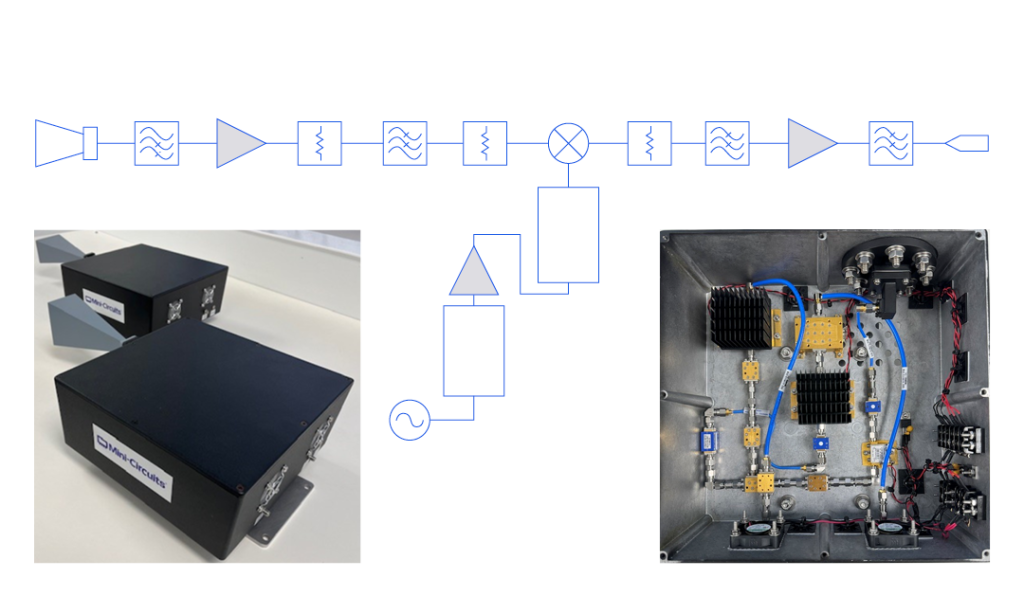
In a receiver, the mixer typically combines an incoming RF signal with a local oscillator signal to produce a lower-frequency intermediate frequency – IF.
Moving the signal to a lower frequency can simplify:
Filtering
Amplification
Digitization
Demodulation
Signal processing
This architecture is widely used in superheterodyne and other frequency-converting receivers.
RF Up-Conversion
In a transmitter, a mixer can combine an IF or baseband signal with a local oscillator to produce a higher-frequency RF output.
The desired output may be the upper or lower mixing product depending on the system architecture.
Up-conversion is used in:
RF transmitters
Signal generators
Communication systems
Radar
Satellite equipment
Frequency-translation test systems
Appropriate filtering or sideband-selection techniques are normally required to suppress unwanted mixer products.
Double-Balanced Mixers
A double-balanced mixer is one of the most widely used passive RF mixer architectures.
Traditional diode implementations use balanced RF and LO structures around a diode ring or similar nonlinear network.
Benefits can include:
Good RF-to-LO isolation
Good LO-to-IF isolation
Broadband operation
Good suppression of unwanted LO and RF feedthrough at the IF port
Good linearity
No DC supply for passive models
Double-balanced mixers are widely used in:
Receivers
Transmitters
Test equipment
Signal generators
Frequency converters
Communications systems
Mini-Circuits offers double-balanced mixers across Core & Wire, LTCC and MMIC technologies.
Triple-Balanced Mixers
A triple-balanced mixer uses additional balanced circuitry to improve performance in applications requiring high linearity, wide bandwidth and strong isolation.
Compared with many conventional double-balanced designs, triple-balanced mixers can provide benefits such as:
Higher linearity
Improved intermodulation performance
Wide IF bandwidth
Good isolation
Better suitability for applications where RF and IF frequency ranges overlap
Triple-balanced mixers generally require greater LO drive than lower-level passive mixer architectures.
They are useful in:
Wideband communication systems
High-dynamic-range receivers
Radar
Electronic test systems
Frequency-agile equipment
Applications requiring high IP3
Active Mixers
An active mixer incorporates active circuitry and therefore requires a DC power supply.
Unlike a conventional passive mixer, which normally introduces conversion loss, an active mixer may provide conversion gain.
Other possible advantages include:
Lower required LO drive
Integrated gain
Compact implementation
High isolation
Simplified system gain budget
Selection should consider:
RF frequency range
LO frequency range
IF bandwidth
Conversion gain
Noise performance
Input P1dB
Input IP3
DC voltage
DC current
Port isolation
Active mixers can be particularly useful where available LO power is limited or where integrated conversion gain simplifies the surrounding signal chain.
I/Q Mixers
An I/Q mixer uses in-phase and quadrature signal paths to support applications where phase and sideband information needs to be preserved or separated.
I/Q mixer architectures can be used for:
Image-reject down-conversion
Single-sideband up-conversion
Quadrature modulation
Quadrature demodulation
Complex signal generation
Communications systems
Radar
Wideband test systems
The I – in-phase and Q – quadrature signal paths differ in phase by approximately 90°.
With suitable external or integrated hybrids and signal processing, this architecture can suppress an unwanted image or sideband.
Mini-Circuits offers both surface-mount and connectorized I/Q mixer solutions, including millimeter-wave models through 65 GHz.
[LINK: READ ABOUT I/Q MIXERS, IMAGE REJECTION & SSB CONVERSION]
Dedicated Up-Converters
Some Mini-Circuits products are optimized specifically for up-conversion applications.
These devices are designed to translate lower-frequency IF signals into higher-frequency RF bands and may provide performance optimized for:
Output frequency coverage
Conversion gain or loss
LO rejection
Linearity
Output matching
Specific IF bandwidths
Dedicated up-converters can simplify transmitter and signal-generator architectures where frequency translation in one direction is the primary requirement.
High-Reliability Mixers
Mini-Circuits offers high-reliability mixer solutions for applications requiring enhanced package integrity and environmental robustness.
Selected families use hermetically sealed ceramic or LTCC-based construction and are suited to applications including:
Aerospace
Defense
Radar
Communications
Instrumentation
High-reliability industrial systems
When environmental or qualification requirements are critical, discuss the exact screening and qualification requirements with MCDI before selecting a product.
Millimeter-Wave Mixers
Mini-Circuits offers MMIC and connectorized frequency mixers for microwave and millimeter-wave applications through 65 GHz.
Selected products provide wide RF and LO bandwidths, wide IF coverage, high isolation and high linearity for applications such as:
5G and advanced wireless
mmWave test and measurement
Radar
Electronic warfare
Satellite communications
Semiconductor characterization
Broadband instrumentation
At millimeter-wave frequencies, connector interface, matching, LO power, isolation and unwanted mixing products become increasingly important.
Core & Wire Mixers
Core & Wire mixer designs use transformer and balun structures together with diode mixing elements.
This established architecture provides:
Wide frequency coverage
Excellent isolation
Good linearity
Multiple LO drive levels
Broad selection of package styles
Mini-Circuits offers many classic ADE, MCA, ZFM, ZAD and related mixer families using Core & Wire technology.
LTCC Mixers
Low Temperature Co-Fired Ceramic – LTCC technology enables compact, repeatable RF structures to be integrated into ceramic packages.
LTCC mixers can offer:
Compact size
Consistent unit-to-unit performance
High reliability
Controlled RF structures
Surface-mount integration
Selected high-reliability mixer families use hermetic ceramic packaging for demanding applications.
MMIC Mixers
Monolithic Microwave Integrated Circuit – MMIC mixers integrate the nonlinear mixer circuitry and associated RF structures onto a semiconductor die.
Benefits may include:
Very wide bandwidth
High repeatability
Compact size
Excellent high-frequency performance
Surface-mount or bare-die formats
mmWave frequency coverage
Mini-Circuits MMIC mixer solutions extend through 65 GHz.
Mixer selection requires considering all three frequency ports together rather than looking only at RF frequency.
RF Frequency Range
First define the RF frequency or frequency range that must be converted.
The selected mixer must meet its conversion-loss, linearity, isolation and matching requirements across the actual RF operating band.
LO Frequency Range
The local oscillator drives the frequency-conversion process.
The LO frequency must be within the mixer’s specified operating range, and the available LO signal level must match the mixer’s required drive level.
IF Frequency Range
The intermediate-frequency port may need to operate from DC or near-DC through several GHz depending on the application.
Check both:
Minimum IF frequency
Maximum IF frequency
This is especially important for:
Wideband receivers
Zero-IF architectures
I/Q mixers
High-frequency converters
Where the manufacturer’s specification begins at 0 MHz, this should be understood as DC IF capability.
LO Drive Level
Passive mixers are designed for a specified LO drive level.
Common Mini-Circuits mixer families are optimized for LO levels including values such as:
+3 dBm
+7 dBm
+10 dBm
+13 dBm
+17 dBm
Higher drive levels for selected products
Active mixers may require considerably less LO power, including selected models designed for LO levels around 0 dBm or below.
Using the appropriate LO drive is important because insufficient or excessive LO power can affect:
Conversion loss
Linearity
Isolation
Spurious performance
Conversion Loss
A passive mixer normally has conversion loss.
Conversion loss describes the difference between the input signal power and the desired converted-output power.
For example, a mixer with 6 dB conversion loss ideally produces the desired converted signal approximately 6 dB below the applied RF input level, subject to the specified operating conditions.
Lower conversion loss can help improve the signal-chain gain and noise budget.
Conversion Gain
Active mixers may provide conversion gain rather than conversion loss.
For these devices, a negative value displayed under a conventional “conversion loss” field actually represents gain.
When comparing active and passive products, distinguish clearly between:
Positive conversion loss
Positive conversion gain
rather than interpreting them as the same type of specification.
LO-to-RF Isolation
LO-RF isolation describes how much local-oscillator energy leaks toward the RF port.
Higher isolation can help reduce:
LO radiation toward an antenna
Interaction with preceding RF stages
Unwanted LO leakage
System-level spurious signals
LO-to-IF Isolation
LO-IF isolation describes how strongly the LO signal is suppressed at the IF port.
Good LO-IF isolation can reduce the burden on IF filtering and downstream circuitry.
Input P1dB
Input P1dB indicates the RF input level at which mixer conversion performance has compressed by approximately 1 dB.
It is useful for understanding how much input signal the mixer can accept before significant nonlinear compression occurs.
Input IP3
Input Third-Order Intercept Point – IIP3 is an important measure of mixer linearity.
Higher IIP3 is generally desirable in systems where:
Multiple signals are present
Strong interferers are expected
Intermodulation distortion must be minimized
High dynamic range is required
Receiver front ends and wideband test systems often place particular importance on IIP3.
Image Frequency
A conventional mixer can translate more than one input frequency to the same IF.
This produces the well-known image-frequency problem in superheterodyne receivers.
Image rejection can be handled through:
RF preselection filtering
I/Q image-reject mixer architectures
Digital signal processing
Appropriate frequency planning
If image rejection is important, include the image-frequency requirement when selecting the mixer and surrounding filters.
Spurious Mixing Products
Real mixers produce additional frequency components associated with combinations of RF and LO harmonics.
These are commonly described using terms such as:
m × RF ± n × LO
System designers should evaluate potentially problematic mixer products, particularly in:
Wideband systems
Frequency-agile equipment
Radar
Multi-band radios
High-dynamic-range receivers
Filtering and careful frequency planning can help prevent unwanted mixer products from falling into the desired signal band.
Port Matching and VSWR
The RF, LO and IF ports should see appropriate source and load impedances.
Mixer performance can be affected by poor or highly reactive terminations, particularly at the IF port of some passive mixer architectures.
Review the manufacturer’s recommended termination and matching conditions.
Passive or Active?
Choose a passive mixer when:
No DC supply is preferred
Sufficient LO power is available
Wide dynamic range is required
Passive simplicity is desirable
Consider an active mixer when:
LO power is limited
Conversion gain is useful
Integration and compact size are important
DC power is available
The correct choice depends on the complete system gain, noise, linearity and power budget.
Surface-Mount, Connectorized, Plug-In or Die?
Choose the mechanical format according to your application.
Surface-mount: PCB-level production integration.
Connectorized: laboratories, test equipment, prototypes and complete systems.
Plug-in: through-hole or legacy PCB integration.
Bare die: hybrid microwave modules, chip-and-wire designs and highly integrated high-frequency applications.
Receiver Down-Conversion
RF mixers are fundamental components in receiver architectures.
They translate incoming RF signals to a lower IF where subsequent:
Filtering
Amplification
Demodulation
Digitization
can be performed more conveniently.
Transmitter Up-Conversion
Mixers translate baseband or IF signals to the desired RF transmission band.
Applications include:
Wireless transmitters
Radar
Satellite communications
Signal generators
Test equipment
Radar
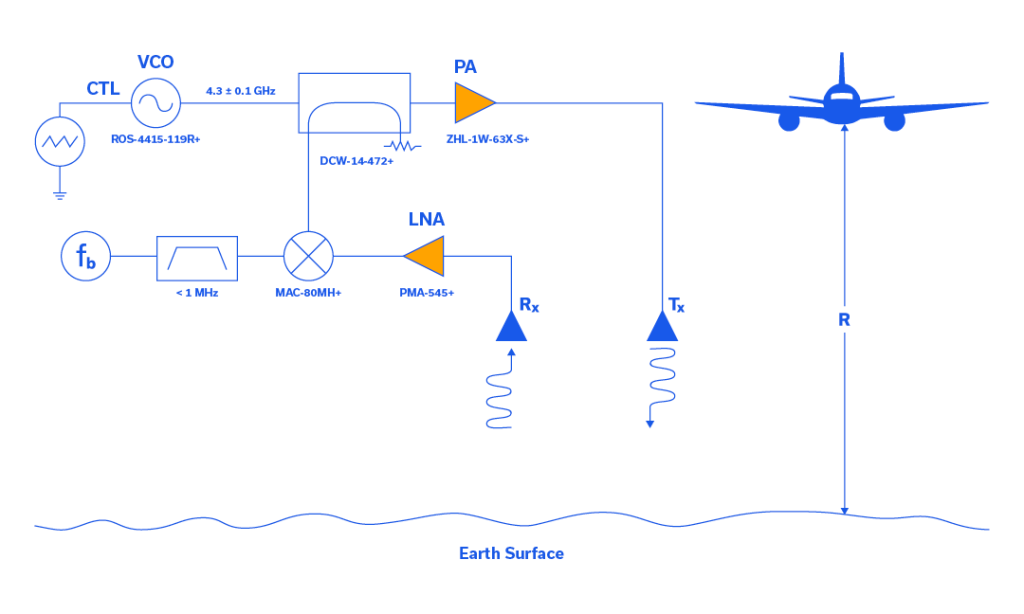
Radar systems frequently require mixers for both transmit and receive frequency conversion.
Important radar mixer characteristics can include:
Wide bandwidth
High linearity
Good isolation
Wide IF bandwidth
High input power capability
Low conversion loss
Satellite Communications
SATCOM systems use mixers to translate signals between RF, microwave and IF frequency bands.
High isolation, linearity and wideband performance may be particularly important in multi-carrier satellite systems.
5G & Advanced Wireless
Wideband MMIC and I/Q mixer solutions support:
5G development
mmWave systems
Wideband transceivers
Base-station equipment
Semiconductor test
Advanced wireless research
RF Test & Measurement
Mixers can be used in:
Frequency converters
Spectrum-analysis systems
Signal generators
Receiver test systems
Automated test equipment
Laboratory frequency translation
Connectorized mixers are particularly convenient for rapid laboratory setup.
Electronic Warfare & Wideband Receivers
Wideband mixers with high linearity and large IF bandwidth can support frequency-agile receiver and signal-monitoring systems.
Careful mixer selection is important where strong interfering signals and a large instantaneous bandwidth are present.
Instrumentation
Mixers are also building blocks in RF instruments where signals need to be translated into a frequency range suitable for measurement or processing.
Mixers naturally generate multiple frequency components, including the desired converted signal and unwanted products.
Filters are therefore commonly placed before or after mixers to:
Reject image frequencies
Select the desired sum or difference product
Suppress LO leakage
Remove RF feedthrough
Reduce harmonics and spurious signals
The impedance presented to a mixer by an adjacent filter can also influence mixer performance.
Mini-Circuits’ reflectionless filters can be useful in mixer applications because they absorb stopband signals rather than reflecting them back toward the mixer.
This can help reduce interaction between the mixer and filter and improve predictable system performance in some applications.
An RF mixer is a nonlinear component that combines signals at different frequencies to generate new frequency components, including the sum and difference of the input frequencies.
It is commonly used to translate signals between RF and IF frequency ranges.
What are RF, LO and IF?
RF is the radio-frequency signal being converted.
LO is the local oscillator signal used to drive the mixing process.
IF is the intermediate-frequency signal produced during down-conversion or applied during up-conversion.
What is down-conversion?
Down-conversion translates a higher-frequency RF signal to a lower intermediate frequency.
A common relationship is:
IF = |RF − LO|
What is up-conversion?
Up-conversion translates an IF or baseband signal to a higher RF frequency using a local oscillator.
The mixer produces sum and difference products, and the desired one is selected by the system architecture and filtering.
What is mixer conversion loss?
Conversion loss is the reduction in desired-signal power caused by the frequency-conversion process in a passive mixer.
It is normally expressed in dB.
Can a mixer provide conversion gain?
Yes.
Active mixers may provide conversion gain rather than loss because they incorporate active circuitry and a DC power supply.
What is LO drive level?
LO drive level is the local-oscillator power required to operate the mixer at its intended performance.
Passive mixers are commonly optimized for specific LO levels such as +7, +13 or +17 dBm, although Mini-Circuits offers products over a wider range.
What happens if the LO power is too low?
Insufficient LO drive can increase conversion loss and degrade isolation, linearity and spurious performance.
Always operate the mixer within its specified LO range.
What is LO-RF isolation?
LO-RF isolation indicates how much LO energy leaks to the RF port.
Higher isolation means less LO leakage toward the RF signal path.
What is LO-IF isolation?
LO-IF isolation indicates how much LO energy appears at the IF port.
Higher isolation can simplify IF filtering and downstream signal processing.
What is the difference between a double-balanced and triple-balanced mixer?
A double-balanced mixer provides inherent balancing and isolation between its RF, LO and IF signal paths and is widely used for broadband frequency conversion.
A triple-balanced mixer uses additional balanced circuitry and can provide improved linearity, wide IF bandwidth and better performance in applications where RF and IF bands overlap, generally at the expense of greater LO drive.
What is an active mixer?
An active mixer contains powered circuitry and requires a DC supply.
It may require lower LO drive than a passive mixer and may provide conversion gain.
What is an I/Q mixer?
An I/Q mixer uses in-phase and quadrature signal paths.
It can support applications such as quadrature modulation, image-reject down-conversion and single-sideband up-conversion.
What is an image frequency?
In a conventional down-conversion architecture, more than one RF frequency can produce the same IF when mixed with the LO.
The undesired RF frequency is called the image frequency.
Preselection filters or image-reject architectures are commonly used to suppress it.
What is input P1dB in a mixer?
Input P1dB indicates approximately where mixer conversion performance compresses by 1 dB as RF input power increases.
It provides an indication of usable input-signal capability.
What is mixer IP3?
Input IP3 is a commonly used measure of mixer linearity.
A higher IP3 generally indicates better resistance to third-order intermodulation distortion in systems containing multiple RF signals.
Why does a mixer generate spurious signals?
Mixers are nonlinear devices.
In addition to the desired sum or difference output, they can generate products involving harmonics of the RF and LO signals.
Filtering and careful frequency planning are therefore important parts of mixer-based system design.
What frequency range do Mini-Circuits mixers cover?
Mini-Circuits currently offers RF frequency mixers covering frequencies from approximately 500 Hz to 65 GHz, depending on mixer type and model.
Does Mini-Circuits offer 65 GHz I/Q mixers?
Yes. Mini-Circuits offers I/Q mixer solutions extending to 65 GHz, including MMIC and connectorized products for wideband frequency-conversion applications.
Does Mini-Circuits offer high-reliability mixers?
Yes. Mini-Circuits offers high-reliability mixer families using ceramic and LTCC-based packaging for demanding applications.
Specific screening or qualification requirements should be confirmed for the selected model.
Can MCDI help select an RF mixer?
Yes. MCDI’s Application Engineering team in Israel can help identify suitable Mini-Circuits frequency mixers according to RF, LO and IF frequency ranges, LO drive, conversion loss or gain, isolation, linearity, architecture and interface requirements.
Why Source Mini-Circuits RF Mixers Through MCDI?
MCDI is Mini-Circuits’ exclusive representative and distributor in Israel, providing Israeli engineers and purchasing teams with access to Mini-Circuits RF, microwave and millimeter-wave products together with local technical, commercial and logistical support.
Local Application Engineering
Mixer selection requires balancing several interdependent parameters.
MCDI’s Application Engineers can help evaluate:
RF frequency
LO frequency
IF frequency
LO drive
Conversion loss or gain
Isolation
Input P1dB
Input IP3
Image-frequency requirements
Package and interface
and identify suitable Mini-Circuits mixer options.
Technical Support in Hebrew and English
Discuss your frequency-conversion requirements directly with an Israel-based engineering team familiar with Mini-Circuits RF components and complete signal chains.
Complete Frequency-Conversion Support
MCDI can assist with related products including:
RF filters
Amplifiers
Oscillators
Frequency synthesizers
Frequency multipliers
Modulators and demodulators
Splitters and hybrids
Attenuators
RF cables
allowing mixer selection to be evaluated as part of the complete system.
High-Reliability and MMIC Solutions
MCDI can help identify Mini-Circuits high-reliability, LTCC, MMIC, bare-die and connectorized mixer solutions according to your mechanical and environmental requirements.
Special & Custom Mixers
If a catalog mixer does not meet the required frequency, LO-drive, linearity, package or other performance requirements, contact MCDI to discuss available special or custom Mini-Circuits solutions.
Support from Selection Through Delivery
MCDI supports customers in Israel from product selection and quotation through ordering, logistics and post-sales technical assistance.
Before you leave, you should know that MCDI’s professional team of Application Engineers will be delighted to assist you in sourcing the right component. Just fill the form and we will be back to you shortly.