
RF Signal Quality Measurements: Third-Order Intercept Point (IP3) and Power at 1 dB Compression (P1dB)
Introduction to Nonlinear Effects: Harmonics and Intermodulation Products
RF signal quality is a key concern when building an RF system. Most RF systems and are designed and built to operate in the linear range. The linear range is the region of operation where the output power is some constant multiple of the input power. When the input is driven past the linear region, non-linear behaviors begin to develop, mainly the generation of harmonics and intermodulation products at the output of the device. Harmonics are unwanted output signals whose frequency is an integer multiple of the input signal frequency.
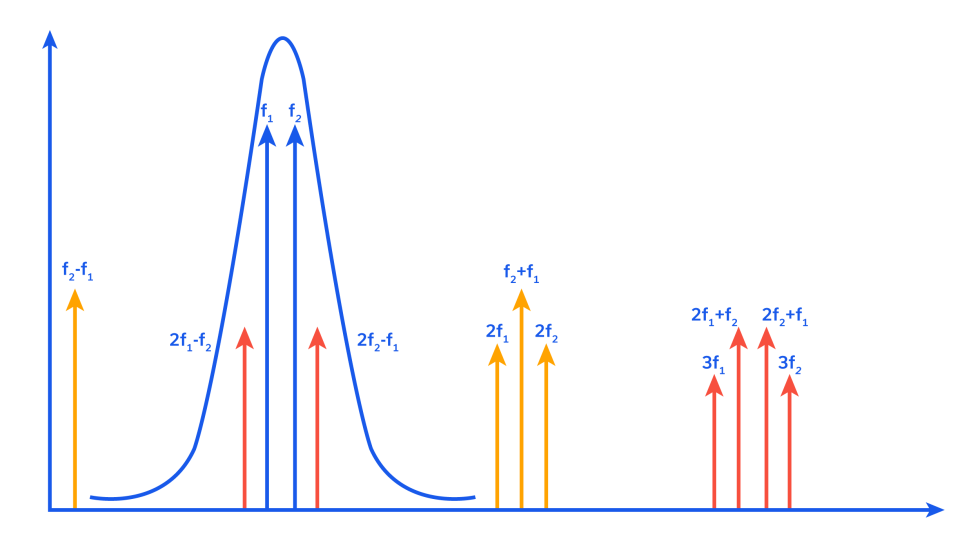
Intermodulation products are a bit more complex. When two closely spaced signals (tones), f1 and f2, are input into a device, and the power into the device is driven into the non-linear range, the two signal frequencies will mix, generating the two original (or “fundamental”) tones along with the sum and difference of the two fundamental frequencies. Further, this mixing with continue with the harmonics of the two input tones. At certain frequencies, namely 2f1-f2 and 2f2-f1, the intermodulation products will be close to the fundamental frequencies (f1 and f2), making them difficult to filter out. As higher-order harmonics and intermodulation products are developed, they tend to be lower in amplitude, thereby reducing their effect on overall signal quality.
Harmonics and intermodulation products are illustrated in Figure 1.
Test Methods for the Linear Range of RF Devices
There are two common tests that can help characterize the linear range performance of RF devices, especially RF amplifiers. The first is the 1dB compression point (P1dB) test. Another is the third order intercept (IP3) test. Mini-Circuits offers a wide variety of test equipment that can be utilized to perform these tests in a precise, repeatable manner. Let’s examine these two tests in more detail.
1 dB Compression Point (P1dB) Test
P1dB or 1dB compression point is used to characterize the linear range of a device. A typical P1dB test configuration is shown in Figure 2.
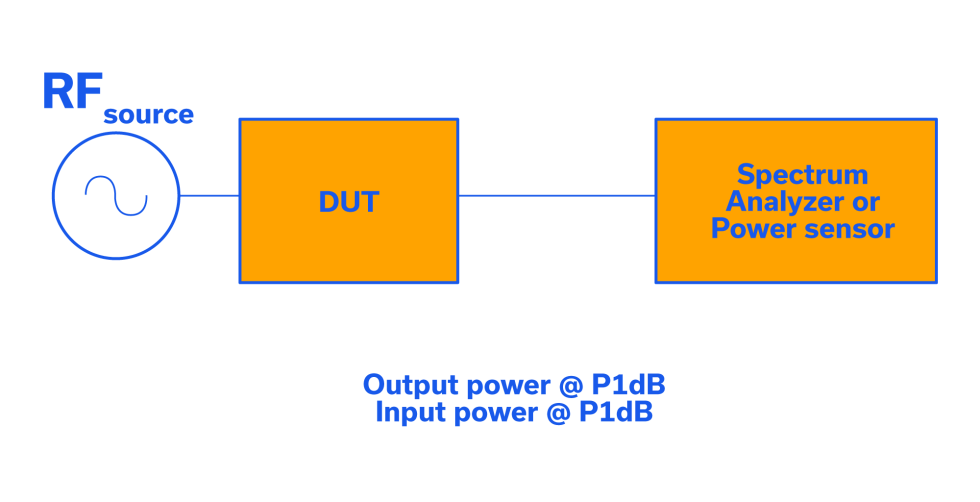
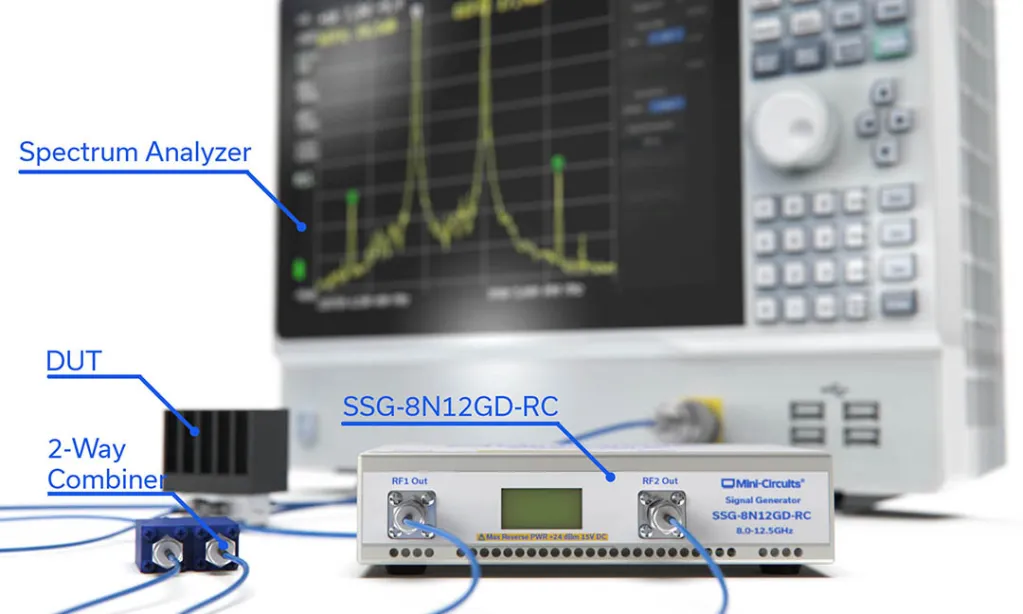
The new Mini-Circuits SSG-8N12GD-RC, a dual channel RF signal generator operating from 8 to 12.5 GHz, can be utilized for the P1dB test. While the dual output is not required for this test, it will be useful for the IP3 test, reducing the amount of test equipment required in the characterization of a given device under test (DUT). To measure the DUT output power, the Mini-Circuits PWR-18RMS-RC true RMS power sensor is an excellent choice.
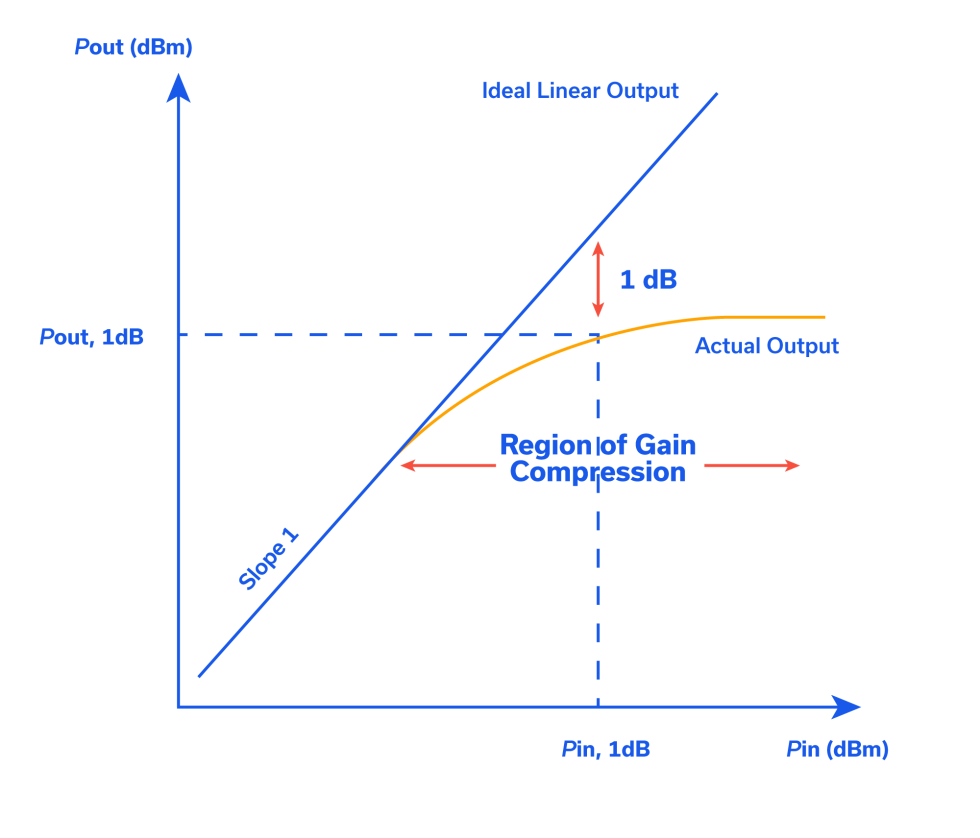
For the 1dB compression point test, The DUT frequency of interest is selected and entered into the test equipment, Next, the RF input of the device (Pin) is increased while measuring the RF power output (Pout). This relationship of RF input power versus RF output power yields a plot similar to that shown in Figure 3. With a low RF input power, the output is at the noise floor. As the RF input power is increased, the device enters the linear operating range. This is where the RF output power is some multiple of the RF input power. This multiple, Pout/Pin, is the gain of the device. Gain remains constant throughout the linear range of the device.
As the RF input is increased further, there comes a point where the device can no longer deliver more RF power out. As the RF input continues to be increased, the RF output will continue to flatten. The point where the actual RF power output deviates from the ideal (linear) RF output by 1 dB is defined as the 1dB compression point. This concept is shown graphically in Figure 3. The 1 dB compression point is generally considered to be the point where the device enters compression and no longer behaves in a linear fashion.
Third Order Intercept (IP3) Test
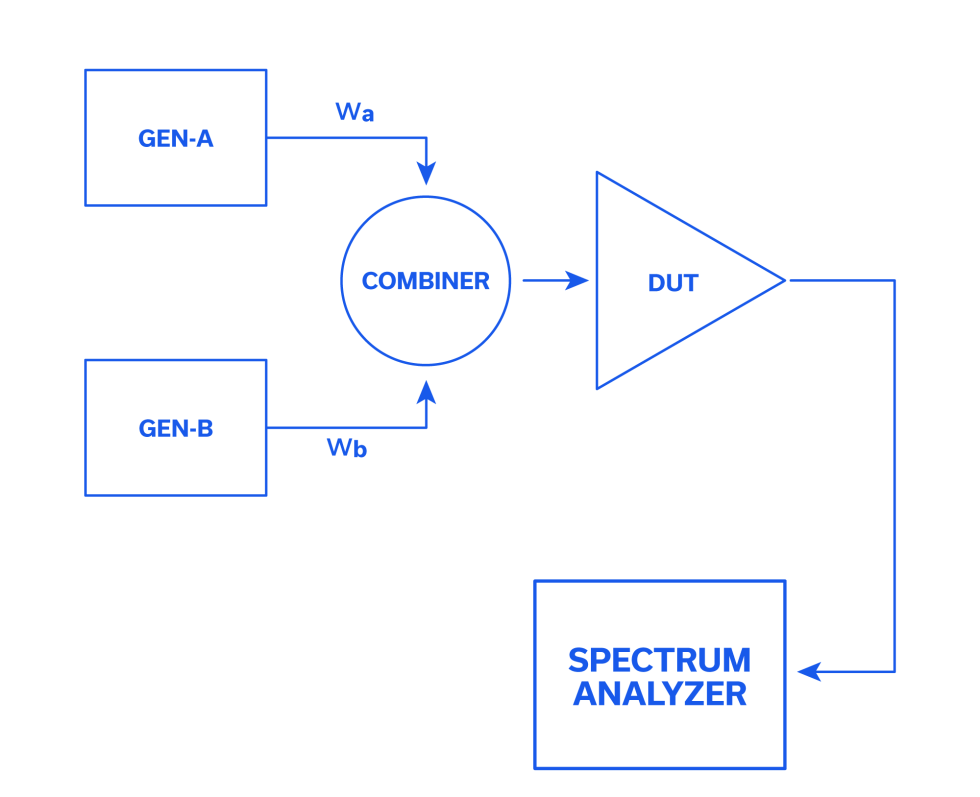
The Third Order Intercept (IP3) is a hypothetical measure of the distortion produced by the device. It is hypothetical because the device will enter compression before it reaches the IP3 point. It can be measured by the two-tone method, Illustrated in Figure 4. The Mini-Circuits SSG-8N12GD-RC dual channel RF signal generator (8 to 12.5 GHz) is again an excellent choice to use for Gen-A and Gen-B in the figure. Other Mini-Circuits RF components, such as cables and combiners may be utilized as well.
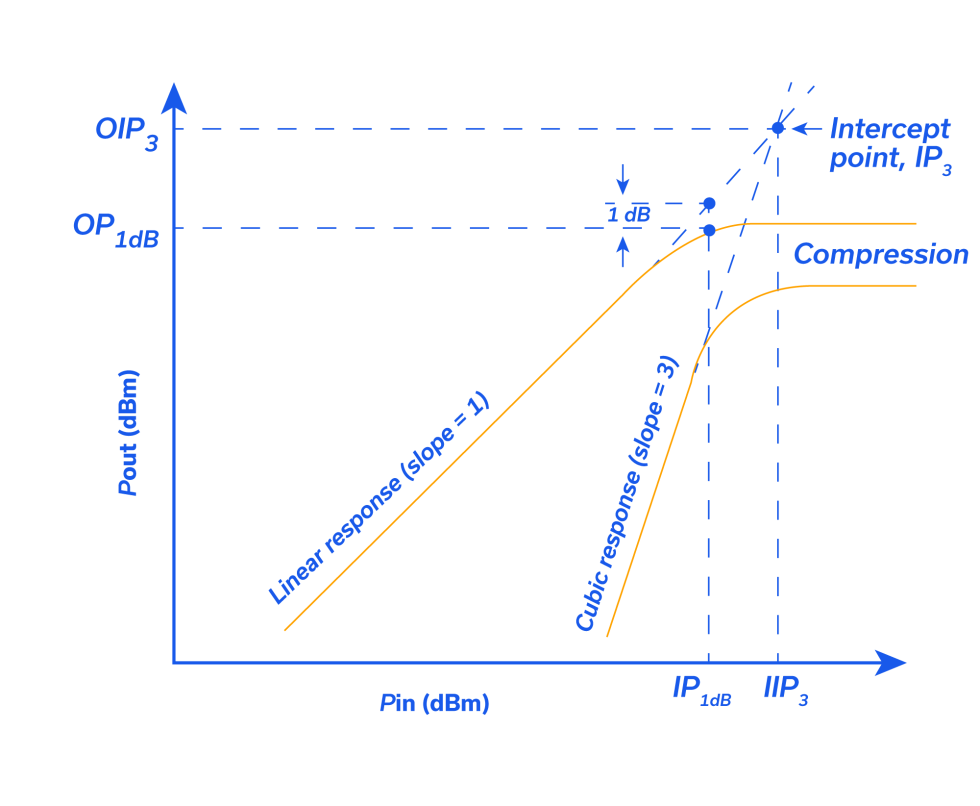
As recalled from earlier discussion and Figure 1, inputting two closely spaced RF signals into the device results in third order intercept products appearing at frequencies near the input signals. These signals are the most likely to cause interference both within the same channel and adjacent channels. The level of third-order products, expressed in dB, increases three times faster than those of the two fundamental first-order (fundamental) input tones. When the two fundamental product powers are equal in amplitude to the third order signals, this is referred to as the third-order intercept point (IP3). Because the amplifier will enter compression before it reaches IP3, its value is determined by extending the measured values to the point where they intersect. This is shown graphically in Figure 5 along with P1dB.
Flexible Solutions for P1dB and IP3 Testing
Developing a reliable test setup for 1dB compression point (P1dB) and third order intercept point (IP3) can aid in characterizing the expected behavior of RF amplifiers and other RF devices in the linear and non-linear ranges of operation. Mini-Circuits portable RF test devices, integrated test solutions and broad selection of components allow these parameters to be measured with a high degree of confidence, while affording the user outstanding flexibility and value.