

TEST
SOLUTIONS
Our integrated switch matrices provide reliable and repeatable signal routing for any application. Blocking, non blocking and full fan-out switch matrices are available using many combinations of mechanical and solid-state switch technologies to meet your unique system requirements.
Best viewed on desktop.
Please use the below filters to narrow down your search according to your required parameters.
You may also sort each column (alphabetic or numeric) by clicking on their header.
Please use the below filters to narrow down your search according to your required parameters.
You may also sort each column (alphabetic or numeric) by clicking on their header.
Fan-Out Operation:
Fan-In Operation:
Please use the below filters to narrow down your search according to your required parameters.
You may also sort each column (alphabetic or numeric) by clicking on their header.
Please use the below filters to narrow down your search according to your required parameters.
You may also sort each column (alphabetic or numeric) by clicking on their header.
Fill out the form if you need help choosing a part, need samples or if you have any questions, and we will get back to you as soon as possible.
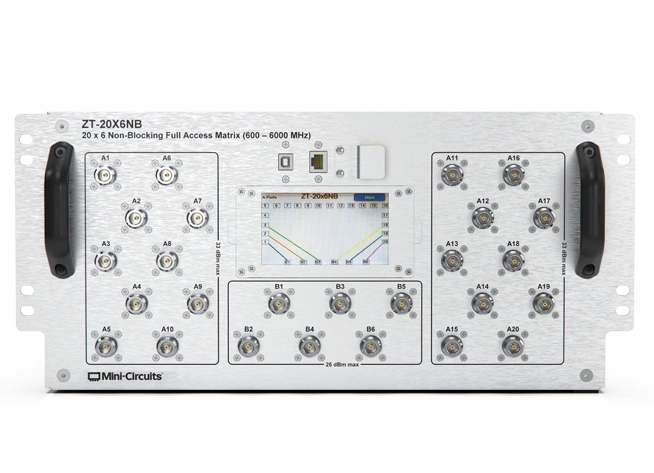
An NxM RF switch matrix is an integrated system that routes signals between N inputs and M outputs under software control, replacing manual cable swapping in complex test setups. Mini-Circuits builds these using combinations of mechanical and solid-state switch technologies, chosen to match the required performance. They’re available in blocking, non-blocking, and full fan-out architectures, with configurations ranging from a compact 4×4 up to 80×30, and all models controlled via USB and LAN.
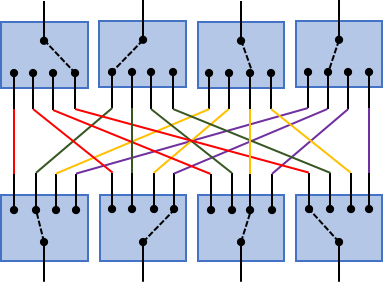
In a blocking matrix, each input connects to a single output at a time — a “one to one” configuration using high-reliability switches on both inputs and outputs. Once a path is established, that input and output are unavailable to other connections, hence “blocking.” In a non-blocking matrix, splitters or combiners are added so that connections can be made without tying up other paths: each input can reach multiple outputs simultaneously. Blocking matrices give the lowest insertion loss and highest isolation; non-blocking matrices give routing flexibility. Both are bi-directional.
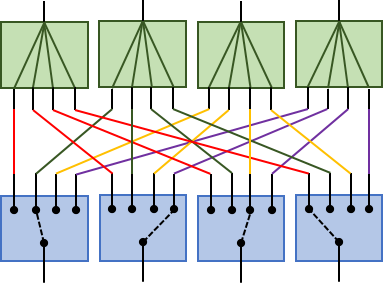
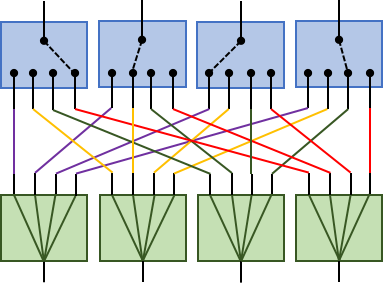
These are the two modes of a non-blocking matrix. Fan-out places splitters on the inputs and switches on the outputs, so a single input can be distributed to multiple outputs at once — ideal for receiver test applications where one signal source must feed many devices under test. Fan-in reverses this, with switches on the inputs and combiners on the outputs, so multiple inputs can be routed into a single output — ideal for transmitter test applications. Both configurations operate bi-directionally.
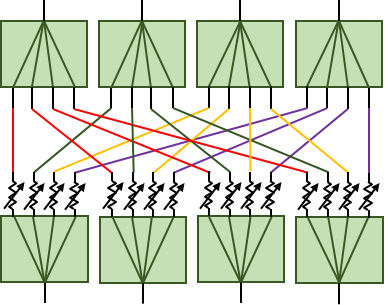
A full fan-out matrix is a “many to many” configuration where all inputs can connect to all outputs simultaneously. Instead of switches, it uses programmable attenuators on each path to vary path loss and to switch paths on or off. This makes it ideal for massive MIMO, eNodeB, mesh radio, and handover test systems, where you need to control the signal level on every input-output combination independently. The ZT-RFX series offers this with 0–63 dB of attenuation per path, in 8×8, 16×8, and 24×8 configurations covering 500–6000 MHz (or 500–7200 MHz on the ZT-8RFX8-6E).
The largest standard configuration is the ZT-80X30NB — a non-blocking 80-input by 30-output matrix covering 600–6000 MHz in a 38U rack with SMA connectors. Among blocking matrices, the ZT-24X48B offers 24 inputs by 48 outputs in a 48U rack, and the ZT-16X48B offers 16×48 in 14U. These large systems consolidate what would otherwise be dozens of individual switches into a single software-controlled unit for large-scale production or multi-DUT test environments.
Several models reach 18 GHz. The ZT-8X8B-1835 is an 8×8 blocking matrix covering DC–18 GHz in a 4U rack, and the ZTVX “-18-S” family provides 2-input distribution up to 18 GHz with 8, 10, 12, or 16 outputs in a compact 2U chassis. A number of models cover DC–12 GHz, including the ZT-175 (6×8, 4U), the ZT-6X3B (6×3, 3U), and the ZTVX “-12-S” series. Most higher-port-count matrices operate in the 600–6000 MHz range typical of cellular and Wi-Fi test.
Yes. The ZTVX “-75-N” family provides 75-ohm matrices with N-type connectors covering 5–2500 MHz, in 2-input configurations with 8, 10, 12, or 16 outputs (models ZTVX-8-75-N, ZTVX-10-75-N, ZTVX-12-75-N, and ZTVX-16-75-N). Rack heights are 3U or 4U. Most RF matrices are 50-ohm, so these are specifically intended for video, CATV, and broadcast distribution where 75-ohm impedance is standard.
Typical applications include multi-channel and MIMO test systems, 4G and 5G radio testing, cellular base-station and handset testing, and satellite communications signal routing. They’re used wherever complex signal traffic must be managed reliably and repeatably — for instance, routing a bank of instruments across many devices under test on a production line, or emulating handover between cells. Full fan-out variants extend this to massive MIMO and mesh radio scenarios where per-path level control is needed.
All models are controlled via USB and LAN, allowing integration into automated test software for repeatable, scripted signal routing. Several models also support daisy-chain control, letting multiple units be linked and managed over a single connection: the ZT-24X8B, ZTVS-16-06-S, and ZT-8X8B among blocking matrices; the ZT-10X30NB and ZT-8X8NB among non-blocking; and the ZT-8RFX8-6E among full fan-out matrices. Daisy-chaining simplifies wiring when several matrices are combined into a larger routing system.
Yes. Beyond the standard catalog, Mini-Circuits builds custom switch matrices using tailored combinations of mechanical and solid-state switch technologies to meet specific system requirements — including non-standard port counts, frequency ranges, connectors, and rack formats. MCDI, the exclusive representative of Mini-Circuits in Israel, has an application engineering team that helps you choose between blocking, non-blocking, and full fan-out architectures, specify the configuration, request samples, and provide local support. Reach MCDI at 077-5406075, via the website contact form, or on WhatsApp.




Before you leave, you should know that MCDI’s professional team of Application Engineers will be delighted to assist you in sourcing the right component. Just fill the form and we will be back to you shortly.