

Impact of Date Code Age Restrictions on Quality, Service, and Value
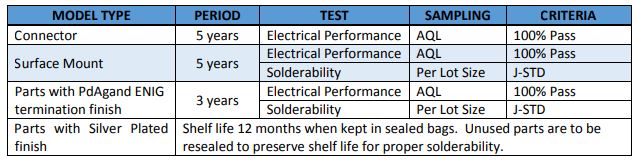
Extensive studies done by industry leaders, NASA and the U.S. military have shown substantial evidence that in modern storage environments, time intervals of five years or longer between manufacture of components and shipment to OEMs pose virtually no risk to the quality or reliability of electronic products. Date code based age restrictions were originally imposed due to concerns about age-related oxidation of eutectic (or tin-lead plated) parts and loss of component solderability. The subsequent replacement of tinlead solder with lead-free solder in RoHS compliant parts has since minimized the cause of this failure mechanism. Additionally, advances in product packaging and storage such as bagging, taping, and moisture control techniques now provide robust protection from electronic degradation and “out-of-the-box” failure due to age for time periods in the order of decades (i). As a result of such findings, the US military has eliminated date code requirements for electronic products altogether (ii), and NASA has significantly relaxed its standards, allowing a five year window before parts in storage are reviewed to determine the need for re-screening (iii).
Using Mini-Circuits Switch Matrices in 75Ω CATV Test Applications
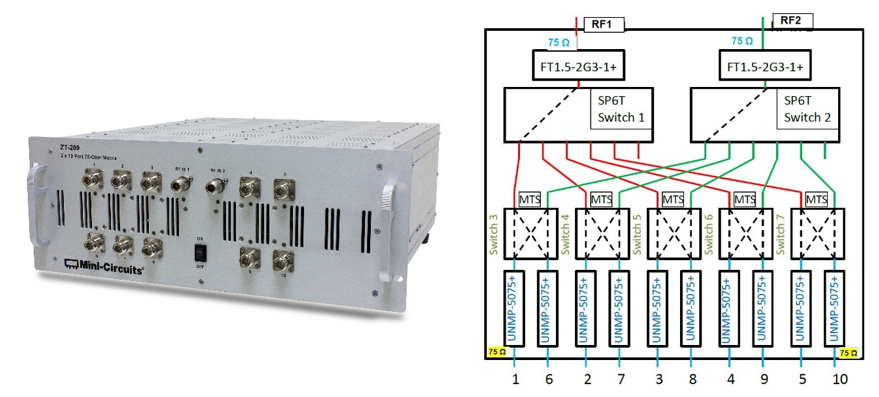
The 75Ω equipment often used in CATV applications occupies a small enclave of a largely 50Ω world. Although dedicated 75Ω equipment does exist, its availability and its applicability to other test needs are limited; most general-purpose test and measurement equipment is designed for 50Ω use. Because of this, it can be difficult to create test setups entirely out of dedicated 75Ω test equipment.
Eliminating Bias Tees from Push-Pull Amplifier Outputs Using TCM3-452X+ 3:1 Unbalanced-to-Balanced Transformer
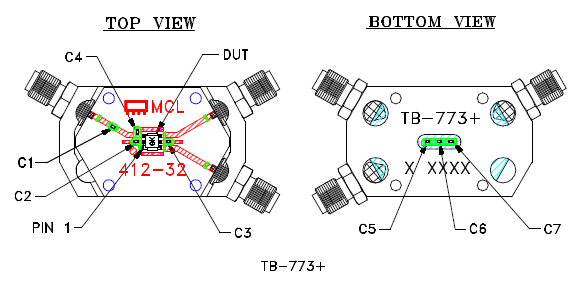
Push-pull amplifiers are used in many multi-octave systems to enhance amplifier output power and efficiency, suppress unwanted harmonics and improve system dynamic range. In a push-pull amplifier design, two matched transistors or amplifiers are supplied by the source signal in parallel and at a 180° phase relationship. When re-combined through a second 180° phase shifting combiner, the fundamental signals are in-phase and combined at twice the power of each half, while the even order harmonics are out-of-phase, creating ideal cancellation of these unwanted signals. In reality, the phase and amplitude unbalance of the splitting-combining circuits result in degradation of the ideal cancellation. However, the net result is still significant suppression of the even harmonics, typically by 20 to 40 dB.
Techniques for Improving Impedance Mismatch
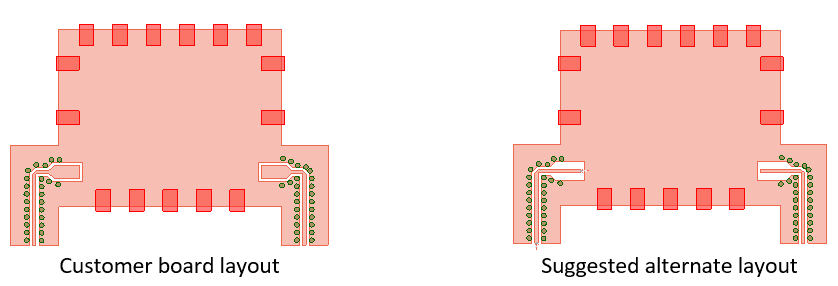
Impedance matching is a complex subject cloaked in a certain degree of mystery. Whenever a circuit fails or systemic problems are encountered, impedance matching is most often attributed as the cause. As a result, there are many situations in which it becomes necessary to match the impedance of a load to that of the source in order to maximize power transfer. There are many different techniques for impedance matching, and the best application of each will depend on the situation. This article will review the basics of impedance matching and describe some of the effective techniques commonly used to overcome impedance mismatch in a circuit.