
Understanding Additive Phase Noise in RF & Microwave Amplifiers – Part 1
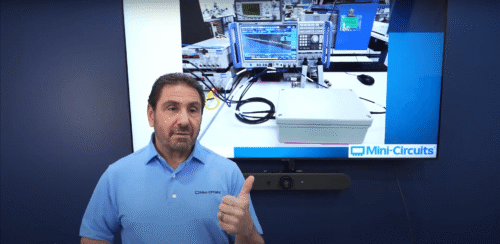
The webinar “Understanding Additive Phase Noise in RF & Microwave Amplifiers – Part 1” features Joe Merenda, Vice President of Engineering at Mini-Circuits, presenting an in-depth overview of additive phase noise (APN) in RF and microwave amplifier systems. Additive phase noise refers to the additional phase noise that an amplifier introduces to an already modulated input signal. This concept is especially important in high-frequency applications such as radar, satellite communication, and wireless systems where phase purity directly affects system performance.

Understanding Additive Phase Noise in RF & Microwave Amplifiers – Part 2
In this second video in our series on RF amplifier additive phase noise, Mini-Circuits VP of engineering, Joe Merenda takes a deeper dive into cascaded amplifiers in LO chains. The discussion explores how to configure lineups of 2 amplifiers in series, and 4 amplifiers in parallel to achieve optimum additive phase noise performance. Testing phase noise in cascade vs. parallel setups, observing noise performance across amplifiers, and characterizing behavior in high-frequency environments are discussed in turn.
About Mini-Circuits:
Mini-Circuits is the world’s preferred supplier of RF and microwave components and systems. With 14 design, manufacturing and sales locations in nine countries, as well as hundreds of sales channel partners worldwide, Mini-Circuits offers 27 product lines comprising over 10,000 active models. Over 20,000 customers choose Mini-Circuits for the demanding quality standards, world-class customer support, on-time delivery and value pricing that have earned the industry’s trust for over 50 years.

Understanding Additive Phase Noise in RF & Microwave Amplifiers – Part 3
In the 3rd and final part of our series on amplifier additive phase noise testing at Mini-Circuits, we continue our investigation into cascaded amplifiers. Part 2 considered two identical amplifiers in series and four identical amplifiers in parallel. However, we were unable to clearly demonstrate the improvement in 1/f noise provided by the parallel configuration due to equipment noise floor limitations.
In Part 3 we address this limitation by driving the four parallel amplifiers with a single amplifier, all identical, and demonstrate that the cascaded performance is dominated by the single driver amplifier.
We also describe how to best optimize the input power levels into each amplifier in order to avoid regions of high AM-to-PM distortion and achieve optimum performance over a wide bandwidth.
About Mini-Circuits:
Mini-Circuits is the world’s preferred supplier of RF and microwave components and systems. With 14 design, manufacturing and sales locations in nine countries, as well as hundreds of sales channel partners worldwide, Mini-Circuits offers 27 product lines comprising over 10,000 active models. Over 20,000 customers choose Mini-Circuits for the demanding quality standards, world-class customer support, on-time delivery and value pricing that have earned the industry’s trust for over 50 years.