

TEST
SOLUTIONS
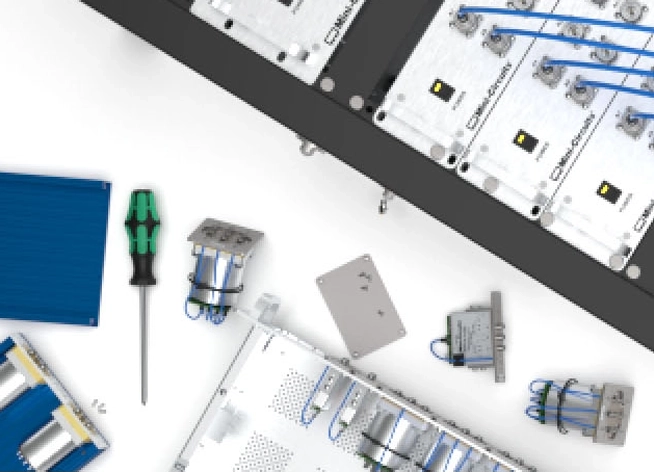
Our experience in the test space has evolved according to your needs. The diversity of customer requirements for highly customized test solutions has led us to build our business around principles of flexibility, reliability, economy and speed. Our wealth and variety of components in stock allows us to take a building-block approach to developing custom equipment for your unique needs with exceptionally fast turnaround.
Best viewed on desktop.
Please use the below filters to narrow down your search according to your required parameters.
You may also sort each column (alphabetic or numeric) by clicking on their header.
| Model # | Frequency(MHz) | Description | Datasheet |
|---|---|---|---|
| ZT-188 | 1600 - 2300 | Wireless Base-State / Handset Test Station | View |
| ZT-228 | 2400 - 2500 & 5700 - 5900 | 4x Wi-Fi Diplexing Amplifier | View |
| ZT-234 | 1 - 3000 | High Power (100W) Switched Load | View |
| ZT-249 | 5 - 1218 | CMTS Diplexed Test Box | View |
| ZT-254 | 1000 - 3000 | Switched Filter Bank | View |
Fill out the form if you need help choosing a part, need samples or if you have any questions, and we will get back to you as soon as possible.
A custom RF test system is a purpose-built, integrated chassis that combines switching, filtering, amplification, attenuation and power handling into a single unit designed around one specific test requirement. You need one when a rack of separate benchtop instruments introduces too much cabling loss, occupies too much space, cannot be calibrated as a single path, or cannot be sequenced fast enough for production throughput. Mini-Circuits builds these on a building-block approach using in-stock components, in both 50 Ω and 75 Ω impedances, with a typical turnaround of 8 weeks.
Typical turnaround is 8 weeks from finalized specification to delivered system. That timeline is achievable because designs are assembled from a large inventory of standard in-stock components — switches, filters, amplifiers, attenuators, splitters and couplers — rather than developing new parts from scratch. Systems that reuse an existing proven configuration can move faster; designs requiring new component development will take longer.
Yes. Every system is 100% RF tested using a LabVIEW-based automated test program, and all systems are fully characterized during production. Characterization means you receive measured performance data for the actual unit shipped — insertion loss, isolation and path response per configuration — not just a generic datasheet, which is what allows the system’s contribution to be de-embedded from your measurements. This is a requirement in most aerospace, defense and regulated production environments.
Yes. Every system ships with a full GUI and API, including a custom GUI with path control functions specific to your configuration, so you can either operate it manually or drive it from your native test software. The API supports integration with LabVIEW, Python, C#, C++ and MATLAB, letting the system drop into an existing test executive as another instrument. Path control functions mean you command a logical signal path rather than individually setting each switch, which substantially reduces test-script complexity and sequencing errors.
Representative delivered systems include the ZT-188 wireless base-station and handset test station (1600–2300 MHz), the ZT-228 4× Wi-Fi diplexing amplifier (2400–2500 MHz and 5700–5900 MHz), the ZT-234 high-power 100 W switched load (1–3000 MHz), the ZT-249 CMTS diplexed test box (5–1218 MHz), and the ZT-254 switched filter bank (1000–3000 MHz). These span cellular, Wi-Fi, cable/DOCSIS and high-power applications, and each can serve as a starting point for a similar requirement rather than a clean-sheet design.
Yes — custom systems are built in both 50 Ω and 75 Ω. The 75 Ω option matters for cable television, DOCSIS/CMTS, broadcast and other video-infrastructure applications, where using a 50 Ω system would introduce mismatch error at every interface. The ZT-249 CMTS diplexed test box (5–1218 MHz) is an example of a system built for that segment.
A switched filter bank is an integrated unit containing several bandpass, lowpass or highpass filters with switches that select one filter path under software control. It is used to suppress harmonics and out-of-band energy in a test setup without an operator manually swapping filters between measurements — essential for automated harmonic testing, spurious emissions measurement and multi-band device characterization. The ZT-254 is a delivered example covering 1000–3000 MHz.
Yes. The ZT-234 is a delivered 100 W switched load system covering 1–3000 MHz, built for applications where transmit power must be routed into calibrated loads rather than into a sensitive instrument. High-power designs require attention to thermal management, load derating and connector selection, so the power level, duty cycle and ambient conditions should be specified early in the design conversation.
The essentials are frequency range, impedance (50 Ω or 75 Ω), the number and type of ports and required signal paths, maximum RF power and duty cycle, required insertion loss and isolation between paths, control interface (USB, Ethernet, TTL, SPI or I²C), rack space available, and target delivery date. Supplying a simple block diagram of the paths you need to switch between usually shortens the quoting cycle more than any other single input. Applications requiring on-site integration should be flagged at the quoting stage, since that service is available but affects scheduling.
MCDI is Mini-Circuits’ exclusive representative in Israel and handles custom test system projects locally — requirements definition, quoting, ordering and post-delivery support — from its office at 077-5406075, Sunday to Thursday 08:00–17:00. Working through MCDI means specification discussions happen in Hebrew or English in your time zone rather than across a large time difference, and on-site integration can be arranged at your facility when the system arrives. MCDI’s application engineers also draw on local stock of Mini-Circuits components, which matters for Israeli defense, aerospace, satcom and semiconductor customers working to short qualification schedules.




Before you leave, you should know that MCDI’s professional team of Application Engineers will be delighted to assist you in sourcing the right component. Just fill the form and we will be back to you shortly.